
Muslim Marriage (Nikah) Laws: Requirements, Forms, and Legal Impediments
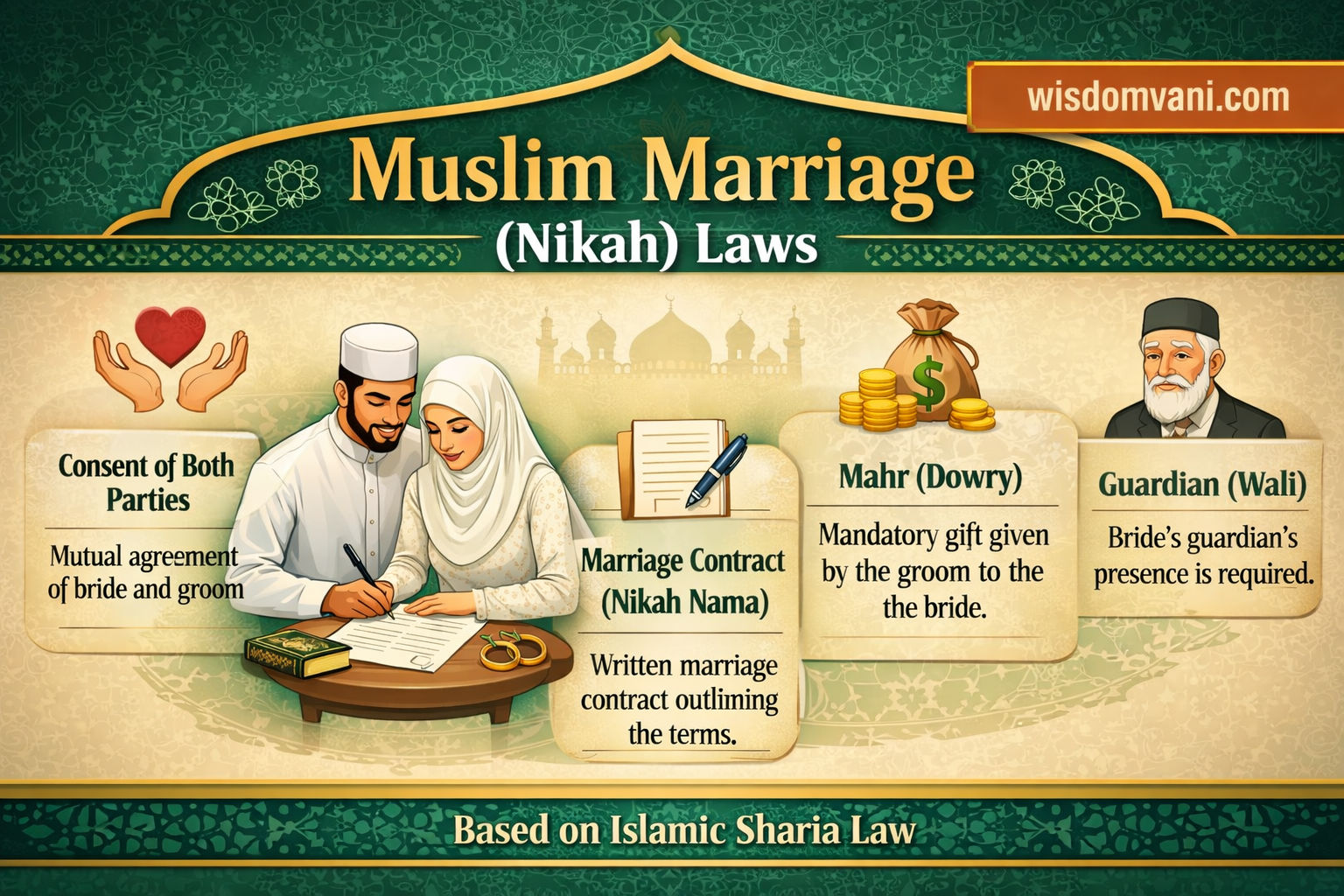
In Islamic law, marriage is not merely a religious sacrament but a civil contract (Nikah) that legalizes sexual union and the procreation of children. For students of personal law, understanding the nuances of this contract—from its essential formalities to the various legal impediments—is crucial. This article explores the legal framework of Muslim marriage, its classifications, and the rights and obligations it creates.
1. Essential Legal Requirements (Essentials of Nikah)
To constitute a valid marriage under Muslim Law, several essential conditions must be satisfied. These are akin to the requirements of a standard civil contract:
- Proposal and Acceptance (Ijab-o-Qubool): The marriage must begin with a proposal (Ijab) from one party and an unconditional acceptance (Qubool) from the other.
- Single Meeting: The proposal and acceptance must occur at the same meeting. A proposal made in one session and accepted in another does not constitute a valid Nikah.
- Capacity of Parties: Both parties must be of sound mind and must have attained puberty (Bulugh). Under Muslim Personal Law, the age of puberty is generally presumed at 15 years, though it can be earlier.
- Free Consent: The consent of the parties (or their guardians, in the case of minors) must be free from coercion, fraud, or undue influence.
- Witnesses:
- Sunni Law: Requires the presence of two sane, adult Muslim male witnesses (or one male and two female witnesses).
- Shia Law: The presence of witnesses is not a mandatory requirement at the time of marriage.
Dower (Mahr): An essential element where the groom provides a sum of money or property to the bride as a mark of respect. It is an obligation imposed by law, even if not explicitly mentioned in the Nikah Nama (marriage contract).
Muslim law classifies marriage based on the degree of compliance with legal formalities:
A. Sahih (Valid)
- A marriage that fulfills all legal essentials and lacks any prohibited impediments.
It confers full legal status on the spouses and the children.
B. Batil (Void)
A marriage is void ab initio (from the beginning) if it violates absolute prohibitions, such as:
Marriage within prohibited degrees of relationship (Consanguinity, Affinity, or Fosterage).
Marrying another man’s wife while her marriage still subsists.
C. Fasid (Irregular)
Unique to Sunni Law, an irregular marriage is one that suffers from a "relative impediment" that can be rectified. Examples include:
Marriage without witnesses.
Marriage with a fifth wife (beyond the permitted four).
Marriage during the Iddat period.
D. Muta (Temporary Marriage)
Recognized only by the Ithna Ashari (Shia) school, Muta is a marriage for a fixed duration. It requires a specified time period and a fixed dower to be valid.
3. Legal Impediments to Marriage
n the study of Muslim Personal Law, a marriage (Nikah) is only legally enforceable if there are no "prohibitions" or "bars" affecting the parties. These impediments are categorized based on whether they permanently or temporarily disqualify a person from marrying another.
- Absolute Impediments (Permanent Bars)
A. Consanguinity (Blood Relationship)
A man is permanently prohibited from marrying his:
Ascendants: Mother, grandmother (how high soever).
Descendants: Daughter, granddaughter (how low soever).
Collaterals: Sister (full, consanguine, or uterine), nieces, and paternal/maternal aunts.
B. Affinity (Relationship by Marriage)
A man is prohibited from marrying certain female relations with whom he has a connection through a valid marriage:
Wife’s mother or grandmothers.
Wife’s daughter or granddaughters (provided the marriage with the wife was consummated).
Father’s wife or any ascendant’s wife.
Son’s wife or any descendant’s wife.
C. Fosterage (Rida)
When a child under the age of two (in some schools, two and a half) is suckled by a woman other than its mother, a "foster relationship" is established.
The Rule: Almost all prohibitions that arise from blood (consanguinity) and affinity also apply to fosterage. A man cannot marry his foster-mother or foster-sister.
- Relative Impediments (Temporary Bars)
A. Unlawful Conjunction
A man cannot marry two women at the same time who are so related to each other that, if one were a man, they could not have married (e.g., two sisters, or an aunt and her niece).
Remedy: The impediment is removed if the husband divorces one of them or one dies.
B. Polygamy (The Fifth Wife Rule)
A Muslim man may have four wives simultaneously. Marrying a fifth wife while the other four are still in a valid marriage is a relative impediment.
Remedy: The marriage becomes regular if one of the first four wives is divorced or dies.
C. Absence of Proper Witnesses
Under Sunni Law, a marriage must be witnessed by two sane, adult Muslim males.
Status: A marriage without witnesses is Fasid (Irregular) but can be validated by subsequent "publicity" or a new ceremony with witnesses.
D. Difference of Religion
Sunni Law: A man may marry a Kitabia (Christian/Jew), but marriage with a fire-worshipper or idolater is irregular.
Remedy: If the spouse converts to Islam or a "Kitabia" religion, the impediment is removed.
E. The Period of Iddat
A woman who is divorced or widowed must observe a waiting period called Iddat. Marrying during this timeframe is prohibited to ensure certainty of paternity.
Status: Under Sunni Law, it is Fasid; under Shia Law, it is Batil.
- Directory and Other Impediments
Marriage during Pilgrimage (Ihram): Parties cannot contract a marriage while in the sacred state of Ihram for Hajj or Umrah (primarily enforced in Shia and Shafi'i jurisprudence).
4. Legal Effects of Marriage
Once a Sahih (valid) marriage is solemnized, it creates a set of reciprocal rights and obligations:
- Legitimacy of Children: Children born of the union are considered legitimate and have the right to inherit property.
- Right to Dower (Mahr): The wife acquires an immediate or deferred right to the dower as stipulated or as "proper dower" (Mahr-ul-Mithl).
- Maintenance (Nafaqa): The husband is legally bound to provide maintenance (food, clothing, shelter) to the wife, regardless of her own wealth.
- Mutual Inheritance: Spouses gain the right to inherit from each other’s estates upon death.
- Legal Restraint: The wife must observe Iddat upon the dissolution of marriage before she can remarry.
- Separate Legal Personality: Marriage does not merge the wife’s legal identity into the husband’s; she retains her property rights and capacity to sue or be sued in her own name.
For law students, Muslim marriage represents a unique blend of contractual principles and religious ethics. While the Nikah is fundamentally a contract, its social and legal consequences—ranging from the strict rules of Mahr to the complex classifications of Fasid and Batil—form the backbone of Islamic family jurisprudence.
Comments 0