
Fundamental Rights in Indian Constitution
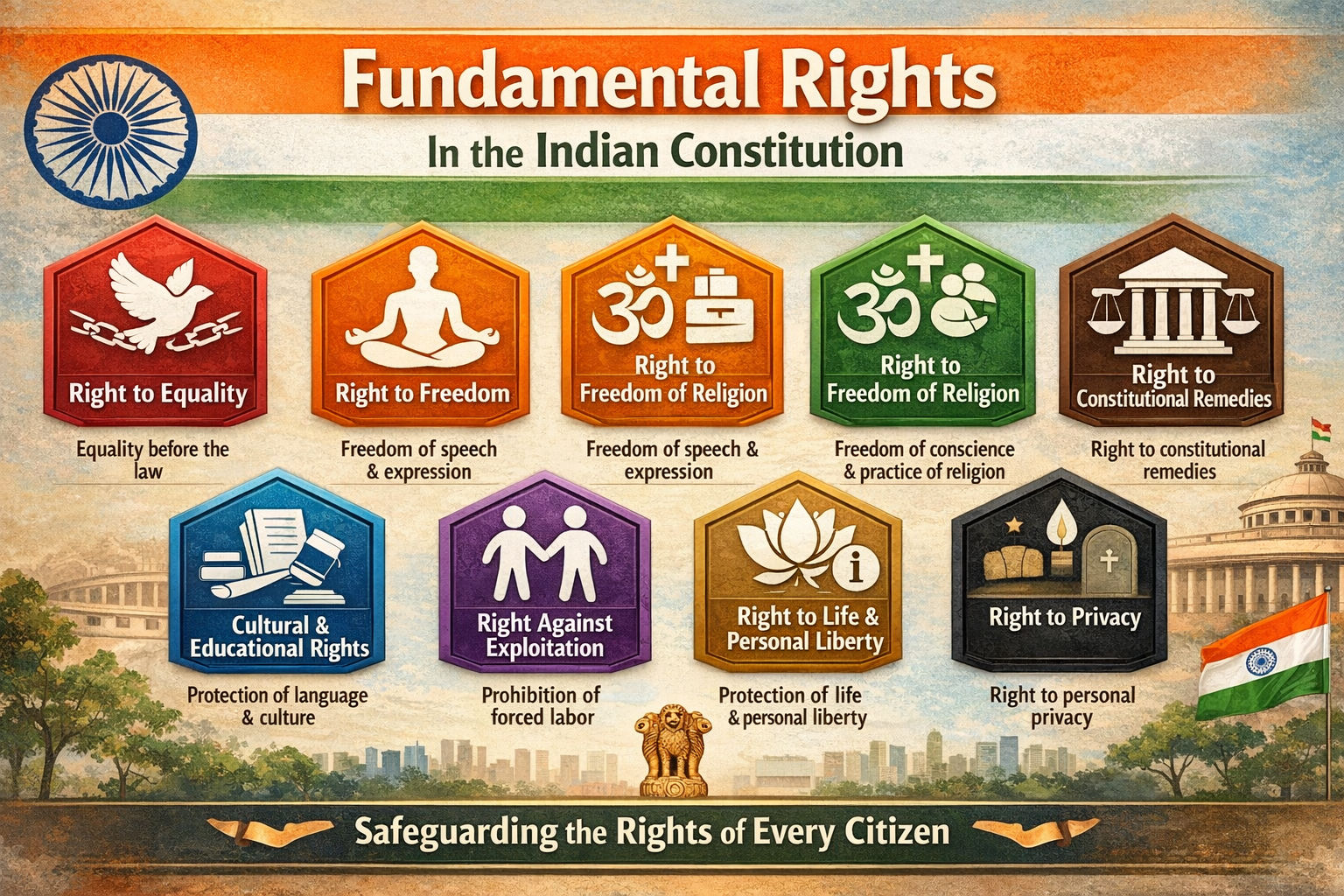
The Constitution of India, which came into force on January
26, 1950, is not just a legal document but a living text that protects the
rights and freedoms of every citizen of the country. The Fundamental Rights,
enshrined in Part III (Articles 12 to 35), are the foundation of democracy in
India. These rights not only protect citizens from the arbitrary power of the
state but also provide them with the opportunity to live a dignified life and
fully develop their personality. They are called "fundamental" because
they are guaranteed by the Constitution and any law or executive action that
violates them can be struck down by the courts.
1. Right to Equality-Articles 14-18
The right to equality is a cornerstone of Indian democracy,
ensuring that no person is superior or inferior before the law.
Article 14: Equality before the law and equal protection of
the laws
This article states that the State shall not deny to any
person equality before the law or the equal protection of the laws within the
territory of India.
Equality before the law: This means that no person is above
the law. All people, regardless of their status or position, are subject to the
general law of the country and shall be treated equally. This is a concept of
British origin.
Equal Protection of Laws: This means that persons in similar
circumstances should be treated equally. It is borrowed from the US
Constitution and aims to eliminate inequalities through affirmative action,
such as reservations for certain groups.
Article 15: Prohibition of Discrimination on Grounds of
Religion, Race, Caste, Sex, or Place of Birth
This article prohibits the state from discriminating between
citizens on these grounds. No citizen shall, on grounds only of these, be
subject to any disability, obligation, restriction, or condition in respect of
the use of public places such as shops, public eateries, hotels, and places of
entertainment, or of wells, ponds, bathing ghats, roads, and public resorts.
However, the state may make special provisions for children or women. Special
provisions (such as reservations) for socially and educationally backward
classes or Scheduled Castes/Tribes are also valid under this article.
Article 16: Equality of Opportunity in Matters of Public
Employment
It ensures that there shall be equality of opportunity for
all citizens in matters relating to employment or appointment to any post under
the state. No citizen shall be disqualified or discriminated against on grounds
of religion, race, caste, sex, descent, place of birth, residence, or any of
them. However, this article allows Parliament to make rules for employment
based on residence under certain circumstances. Reservations for backward
classes are also provided under this article to ensure equal opportunities for
historically disadvantaged sections of society.
Article 17: Abolition of Untouchability
This is a very important article of the Indian Constitution
that abolishes untouchability and prohibits its practice in any form. Enforcing
any disability arising from untouchability is a crime punishable by law. This
article was a revolutionary step towards establishing social equality.
Article 18: Abolition of Titles
This article prohibits the state from conferring any title,
except for military or academic distinction. No Indian citizen shall accept any
title from a foreign state. It promotes the principle of equality and ensures
that individuals are recognized on the basis of their merit rather than their
birth or status.
2. Right to Freedom - Articles 19-22
The right to freedom allows individuals to express their
opinions, assemble, and pursue their livelihoods, which is essential for a
vibrant democracy.
Article 19: Protection of Certain Rights
This article provides citizens with six types of freedoms:
Freedom of Speech and Expression: This is one of the most
important freedoms, giving citizens the right to freely express their thoughts
and beliefs through oral, written, printed, or any other medium. This also
includes freedom of the press. However, this freedom is not absolute and
reasonable restrictions can be imposed on it based on state security, public
order, defamation, morality, etc.
Freedom to assemble peacefully and without arms: Citizens
can assemble peacefully and without arms, such as for protests, meetings, or
processions.
- Freedom to form associations or unions or co-operative societies: This allows individuals to form political parties, clubs, organizations, or co-operative societies.
- Freedom to move freely throughout the territory of India: Citizens can travel freely to any part of the country.
- Freedom to reside and settle in any part of the territory of India: Citizens are free to reside and settle in any part of the country.
- Freedom to practice any profession, or to carry on any occupation, trade, or business: This gives citizens the right to choose and carry on any lawful profession of their choice.
Article 20: Protection against conviction for crimes
This article protects individuals from arbitrary and
excessive punishment. It includes three provisions:
- Protection from ex-post facto law: No person shall be punished for an act which was not an offence by law at the time of the commission of the offence.
- Protection from double jeopardy: No person shall be punished more than once for the same offence.
- Protection from self-incrimination: No person shall be compelled to be a witness against himself.
Article 21: Protection of Life and Personal Liberty
This is one of the most important and comprehensive articles
of the Indian Constitution. It declares that "No person shall be deprived
of his life or personal liberty except according to procedure established by
law."
The Supreme Court has interpreted this concept of 'life'
very broadly, encompassing not only physical existence but also the right to
live with dignity. This includes:
- The right to live with human dignity.
- The right to a clean environment.
- The right to health.
- The right to shelter.
- Right to Privacy.
- Right to a Speedy Trial.
- Right to Legal Aid.
- Right to Education (which later became a separate Fundamental Right).
Article 21A: Right to Education
This was added by the 86th Constitutional Amendment Act,
2002. It declares that "the State shall provide free and compulsory
education to all children of the age of six to fourteen years in such manner as
the State may, by law, determine." This ensures that access to education
is a fundamental right.
Article 22: Protection from Arrest and Detention
This article provides certain safeguards to a person arrested
or detained:
- Right to be informed of the grounds for arrest.
- Right to consult and be defended by a lawyer of one's choice.
- Right to be produced before a Magistrate within 24 hours of arrest (excluding the time of travel).
- Right not to be detained for more than 24 hours without a Magistrate's order.
However, these safeguards do not apply to enemy aliens and
individuals arrested under preventive detention laws. Preventive detention laws
allow the state to detain a person without trial to prevent future crimes, but
are subject to certain constitutional limitations and procedures.
3. Right Against Exploitation - Articles 23-24
This right protects individuals from exploitative practices
such as forced labor and child labor.
Article 23: Prohibition of Human Trafficking and Forced
Labor
It prohibits human trafficking (buying and selling of
persons), forced labor (forced labor without pay), and other similar forms of
forced labor. Any violation of these provisions is a crime punishable by law.
This article applies not only to citizens but also to non-citizens. However,
the state may impose compulsory service (such as military service) for public
purposes.
Article 24: Prohibition of Employment of Children in
Factories, Etc.
This article states that "No child below the age of
fourteen years shall be employed in any factory or mine or engaged in any other
hazardous employment." This article protects children's right to health
and education and is an important step towards eliminating child labor.
4. Right to Freedom of Religion - Articles 25-28
India is a secular country, and this right guarantees every
citizen the freedom to follow any religion of their choice.
Article 25: Freedom of Conscience and Right to Profess,
Practice, and Propagate Religion
This guarantees every person the right to freedom of
conscience and the equal right to freely profess, practice, and propagate their
religion, subject to public order, morality, and health.
Profess: Publicly declaring one's religious beliefs.
Practice: Performing religious rituals, ceremonies, and
forms of worship.
Propagate: Propagate or spread the tenets of one's religion
to others. However, this does not include forced conversion.
Article 26: Freedom to Manage Religious Affairs
This grants every religious denomination or any section
thereof the following rights, subject to public order, morality, and health:
- The right to establish and maintain institutions for religious and charitable purposes.
- The right to manage its own religious affairs.
- The right to own and acquire movable and immovable property.
- The right to administer such property in accordance with law.
Article 27: Freedom from Payment of Taxes for the Promotion of a Particular Religion
This article states that no person shall be compelled to pay
any tax, the proceeds of which are used exclusively for the promotion or
maintenance of any particular religion or religious denomination. This reflects
the secular nature of the State.
Article 28: Freedom from Participation in Religious
Instruction or Religious Worship in Certain Educational Institutions
This grants freedom regarding participation in religious
instruction or religious worship in certain educational institutions.
No religious instruction shall be provided in any
educational institution wholly maintained out of State funds.
In institutions recognised by the State or receiving aid out
of State funds, persons shall not be compelled to attend religious instruction
or attend religious worship unless they themselves or their guardians have
given their consent.
5. Cultural and Educational Rights - Articles 29-30
These rights help minority groups preserve their distinct
culture, language, and education.
Article 29: Protection of Interests of Minorities
It states that any section of citizens residing in the
territory of India or any part thereof shall have the right to preserve its
distinct language, script, or culture. No citizen shall be denied admission
into any educational institution maintained by the State or receiving aid out
of State funds on grounds only of religion, race, caste, language, or any of
them.
Article 30: Right of Minorities to Establish and Administer
Educational Institutions
This gives all minorities (whether based on religion or language)
the right to establish and administer educational institutions of their choice.
The State shall not discriminate against them while providing aid to such
institutions. It ensures that minorities can provide education to their
children in accordance with their cultural identity and traditions.
6. Right to Constitutional Remedies - Article 32
Article 32 of the Constitution is the heart and soul of
fundamental rights. Dr. B.R. Ambedkar called it the "heart and soul"
of the Constitution.
Article 32: Remedies for Enforcement of Fundamental Rights
This right, itself a fundamental right, empowers citizens to
approach the Supreme Court directly in case of violation of their fundamental
rights. The Supreme Court and High Courts (under Article 226) can issue various
writs to enforce fundamental rights:
Habeas Corpus: "You must produce your body." This
writ is issued for the release of a person who has been illegally detained.
Mandamus: "We command." It is issued to direct a
public officer or public body to perform its legal duty.
Prohibition: "To restrain." It is issued by a
higher court to prevent a subordinate court from exceeding its jurisdiction.
Certiorari: "To be certified" or "To be
informed." It is issued by a higher court to a subordinate court to set
aside an order passed by it or to transfer a case to itself.
Quo Warranto: "By what authority?" It is issued to
prevent a person from illegally occupying a public office.
This right ensures that fundamental rights do not remain
merely on paper, but are real and enforceable.
Nature and Importance of Fundamental Rights
Justiciable and Enforceable: Fundamental rights are
justiciable, which means that a person can approach the court if they are
violated.
Universal: These rights are equally available to all
citizens, regardless of their caste, religion, gender, or status.
Not absolute, with some exceptions: Although they are
fundamental, they are subject to certain reasonable restrictions that may be
imposed in the public interest, the security of the state, or to maintain
public order.
Amendable: Parliament can amend fundamental rights through
the constitutional amendment process, but such amendment cannot violate the
Constitution's "basic structure," as held by the Supreme Court in the
Kesavananda Bharati case.
Suspendable: During a national emergency (Article 352), fundamental
rights, except Articles 20 and 21, can be suspended.
Conclusion
The fundamental rights of the Indian Constitution not only
guarantee individual liberty and equality but also pave the way for building an
inclusive and just society. These rights act as a check on the government and
make citizens aware of their rights. They are the pillars of Indian democracy,
and without them, the vision of the Indian Republic is incomplete. It is the
duty of every citizen to understand, protect and respect these rights, so that
India remains a free, just and egalitarian nation.
Comments 0