
Schools of Jurisprudence
Introduction
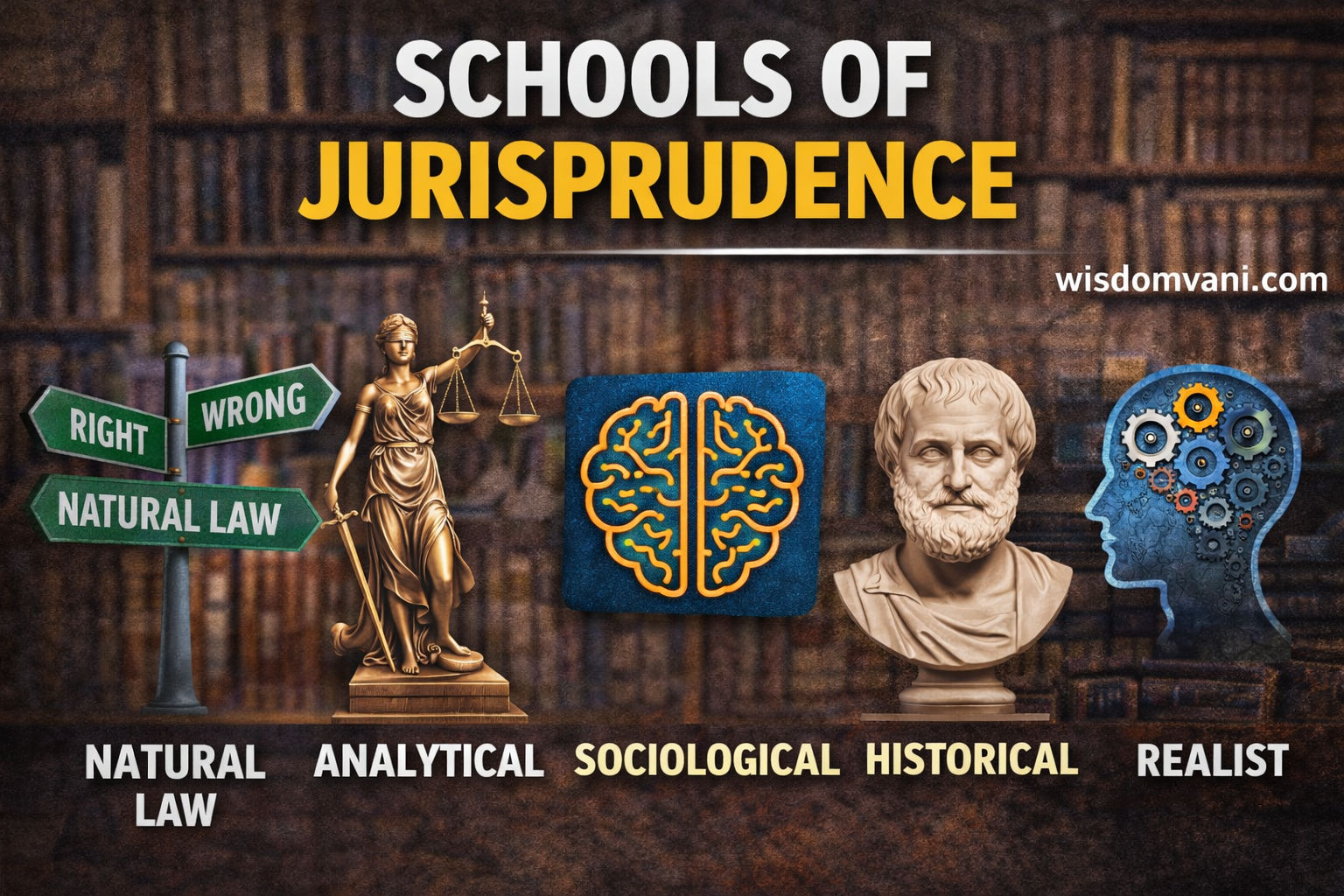
Jurisprudence, derived from the Latin terms juris (law) and prudentia (knowledge or skill), is the study of the fundamental principles underlying legal systems. Before we can argue what the law says, we must understand why it exists and where its authority comes from. This is where the Schools of Jurisprudence come in. These schools are not just historical movements; they are the different "lenses" through which we view the legal world.
Whether we believe law comes from a divine moral code, the command of a King, the traditions of the people, or the practical decisions of a judge, our perspective determines how we interpret justice. In this article, we will break down the primary schools of thought that have shaped modern legal systems across the globe.
1. Natural Law School
The Natural Law School is the oldest school of jurisprudence. It is based on the belief that there is a higher, objective law that is inherent in human nature and discoverable by reason.
Core Philosophy: Law is not just what is written; it is what is "right." An unjust law is not a law at all (Lex iniusta non est lex).
Source of Law: Divine providence, nature, or human reason.
Key Thinkers: * Aristotle: Viewed justice as a natural phenomenon.
Thomas Aquinas: Linked natural law with divine law.
John Locke: Argued for natural rights like life, liberty, and property.
In modern times, Natural Law serves as the foundation for Human Rights and constitutional principles like "Reasonableness" and "Natural Justice."
2. Analytical (Positivist) School
Often called the "Imperative School," the Analytical School focuses on the law as it exists today (Law as it is), rather than how it ought to be.
Core Philosophy: Law is the command of a sovereign backed by a sanction (punishment). It separates law from morality.
Key Thinkers:
John Austin: Defined law as the "command of the sovereign."
Jeremy Bentham: The father of Utilitarianism, focusing on the "greatest happiness of the greatest number."
H.L.A. Hart: Introduced the idea of Primary Rules (conduct) and Secondary Rules (procedure).
Hans Kelsen: Developed the "Pure Theory of Law" and the concept of the Grundnorm (the basic, fundamental norm from which all other laws derive power).
This school is the backbone of modern legal systems where the written Constitution or Parliament is the ultimate authority.
3. Historical School
The Historical School emerged as a reaction against the Analytical School. It argues that law is not made by a sovereign but is found within the history and spirit of the people.
Core Philosophy: Law evolves over time like language. It is a product of social customs and economic factors.
Key Concept: Volksgeist: Friedrich Carl von Savigny introduced this term, meaning the "common consciousness of the people."
Key Thinkers:
Savigny: Believed that law grows with the growth of people and dies when the people lose their individuality.
Sir Henry Maine: Famous for the theory that progressive societies move from "Status to Contract"—meaning individuals moved from being defined by birth/caste to being defined by individual agreements.
4. Sociological School
This school treats law as a social phenomenon. It shifts the focus from legal abstractions to the actual impact of law on society.
Core Philosophy: Law is an instrument of social progress and a tool to balance competing interests.
Key Concept: Social Engineering: Roscoe Pound compared lawyers to engineers, suggesting they should build a structure of society that causes the least friction and waste.
Key Thinkers:
Roscoe Pound: Categorized interests into private, public, and social interests.
Rudolf von Ihering: Viewed law as a way to serve the purposes of society.
This school is particularly relevant in "Judicial Activism," where judges interpret laws to ensure social justice.
5. Realist School
The Realist School (Legal Realism) is a 20th-century movement that focuses on the reality of the courtroom.
Core Philosophy: "The life of the law has not been logic; it has been experience." Law is not just found in books but in the behavior of judges and lawyers.
Key Factors: Realists argue that a judge’s background, prejudices, and social views influence their decisions more than cold legal logic.
Key Thinkers:
Oliver Wendell Holmes Jr.: Stated that law should be viewed from the perspective of the "Bad Man"—someone who only cares about the practical consequences (punishment) of his actions.
Karl Llewellyn: Focused on "Law in Action" vs "Law in Books."
Conclusion: Bridging Theory and Practice
In the grand architecture of a legal system, the Schools of Jurisprudence serve as the foundation. While they may seem like abstract concepts found only in dusty textbooks, they are actively at play in every courtroom and legislative session.
When a judge strikes down an unfair law based on "human dignity," they are channeling Natural Law.
When a lawyer argues that the court must follow the literal wording of a statute, they are practicing Legal Positivism.
When a court modernizes a rule to fit the needs of a digital society, they are applying Social Engineering.
No single school has all the answers; rather, modern law is a "legal cocktail"—a blend of authority, history, morality, and social utility. For a law student, mastering these schools is the first step toward moving beyond rote memorization. It allows you to anticipate judicial trends, craft more persuasive arguments, and ultimately understand the soul of the legal profession. As you progress in your studies, remember that the law is not a static document, but a dynamic dialogue between these competing philosophies.
Comments 0