
Public Interest Litigation (PIL) in India: History and Landmark Cases
1.
Introduction
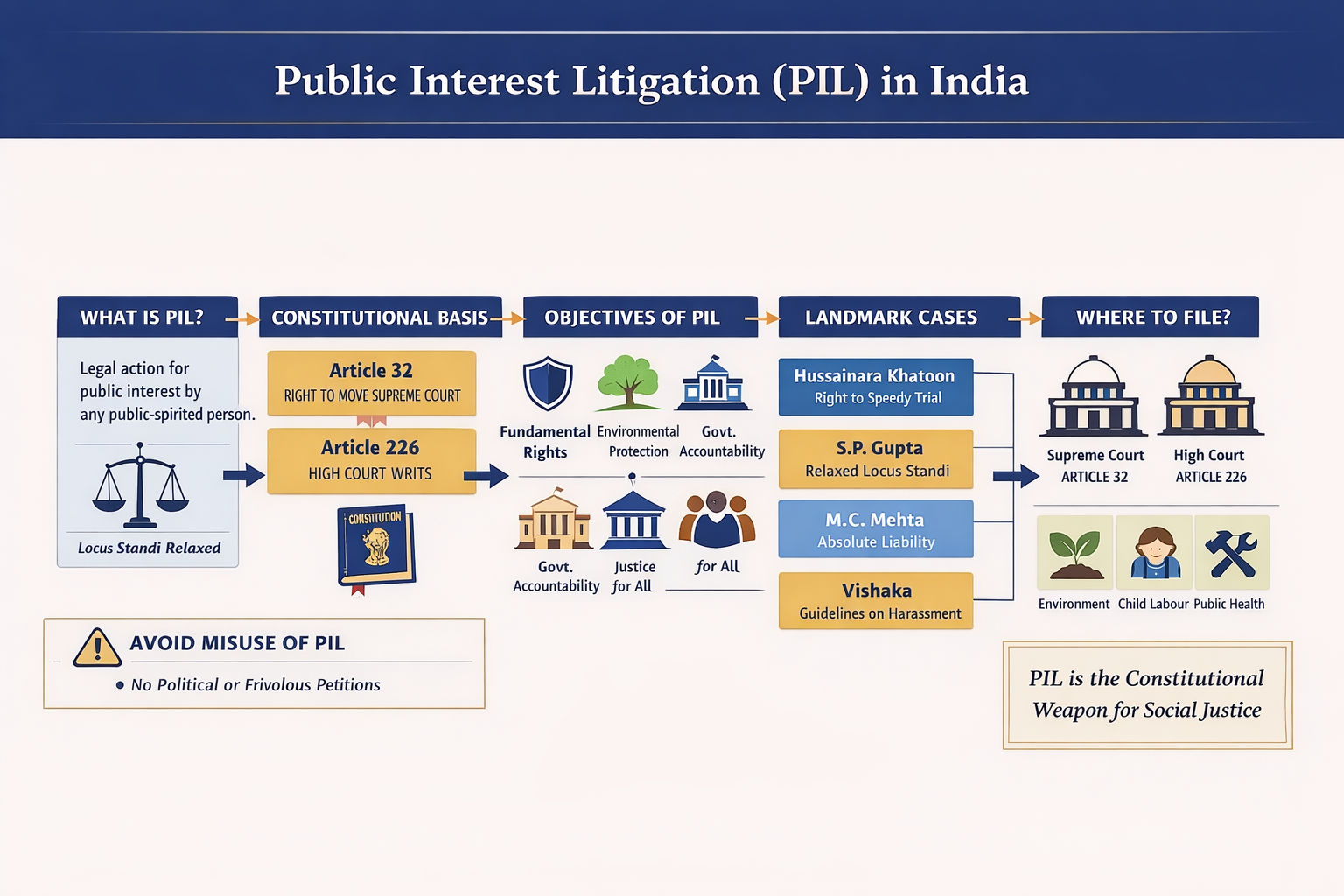
Public Interest Litigation (PIL) is
one of the most powerful judicial innovations in India. It allows any
public-spirited individual or organization to approach the court for the
protection of "Public Interest," even if they are not personally affected.
- Locus Standi:
Unlike traditional litigation, which requires locus standi (only
the aggrieved person can sue), PIL relaxes this rule to ensure justice for
the marginalized who cannot reach the court due to poverty or social
disability. PIL has transformed the role of Indian Judiciary from a
passive dispute resolver to active protector sections of society.
2.
History and Evolution (The Three Phases)
The evolution of PIL in India can be
divided into three distinct phases:
- Phase I (Late 1970s):
Focused on the rights of marginalized groups like under-trial prisoners
and bonded laborers. (Example: Hussainara Khatoon Case).
- Phase II (1980s - 1990s): The focus shifted toward environmental protection,
human rights, and government accountability. (Example: M.C. Mehta Cases).
- Phase III (2000s - Present): Focus on transparency, corruption in public offices,
and policy-level reforms.
3. Objectives of PIL
The main objectives of PIL are:
- Protection of Fundamental Rights
- Providing justice to marginalized communities
- Ensuring government accountability
- Promoting rule of law
- Addressing issues of environmental protection, bonded
labour, prison reforms, corruption, and human rights
4. The Fathers of PIL in India
PIL was pioneered by two legendary
judges:
- Justice P.N. Bhagwati: Known as the "Father of PIL in India."
He famously said that the court must innovate new methods to provide
access to justice for the masses.
- Justice V.R. Krishna Iyer: He laid the initial foundation and believed that law
should reach the doorstep of the poor.
5.
Constitutional Basis and "Epistolary Jurisdiction"
- Articles:
PIL is filed under Article 32 (Right to move the Supreme Court for
enforcement of Fundamental Rights) and Article 226 (Power of High
Courts to issue writs).
- Epistolary Jurisdiction: This is a unique feature where the court can treat even a simple letter or postcard addressed to the Chief Justice as a formal writ petition. This was famously seen in the case of Sunil Batra v. Delhi Administration.
Also Read: What are Writs? Types, Uses, and Legal Rights Explained
6. Landmark Judgments (Must-Include Cases)
(i) Hussainara Khatoon v. State of Bihar (1979): This case exposed the condition of undertrial prisoners in Bihar who had been detained for years without trial.
Importance:
·
Recognized Right to Speedy Trial
as part of Article 21 (Right to Life and Personal Liberty).
· Marked the beginning of judicial activism through PIL.
(ii) S.P. Gupta v. Union of India (1981): This case formally recognized and expanded the concept of PIL.
Importance:
- Relaxed the rule of locus standi.
- Allowed public-spirited individuals to file petitions
on behalf of those who cannot approach the court themselves.
(iii) M.C. Mehta v. Union of India(1987): This case arose from the Oleum Gas Leak from a factory in
Delhi.
Importance:
- Introduced the principle of Absolute Liability.
- Strengthened environmental jurisprudence in India.
- Established that industries engaged in hazardous
activities are strictly liable for damage caused.
(iv) Vishaka v. State of Rajasthan
(1997): This case dealt with sexual
harassment at the workplace.
Importance:
- Laid down the Vishaka Guidelines for prevention
of sexual harassment.
- Recognized gender equality under Articles 14, 19, and
21.
- Later led to the enactment of the Sexual Harassment of
Women at Workplace Act, 2013.
(v) People's Union for Democratic Rights v. Union of India (1982): This case addressed exploitation of workers employed in the construction of Asian Games projects.
Importance:
- Strengthened labour rights.
- Held that non-payment of minimum wages violates Article
23 (Prohibition of forced labour).
7.
Procedure to File a PIL
A PIL can be filed in:
- Supreme Court under Article 32
- High Court under Article 226
Also Read: Fundamental Rights in Indian Constitution
Steps generally include:
- Filing a writ petition with relevant facts and public interest involved.
- Submitting supporting documents and affidavits.
- Court examines whether the issue involves genuine public interest.
Even letters and postcards have been
treated as writ petitions in earlier PIL cases.
8.
Scope of PIL
PIL can be filed in matters relating
to:
- Environmental protection
- Human rights violations
- Prison reforms
- Child labour and bonded labour
- Corruption in public offices
- Protection of constitutional rights
However, PIL cannot be filed for:
- Personal grievances
- Political motives
- Private disputes
9.
Misuse and Recent Guidelines
While PIL is a boon, the courts have
warned against "Frivolous PILs" (filed for personal gain or
publicity). In State of Uttaranchal v. Balwant Singh Chaufal (2010), the
Supreme Court issued 8 guidelines to prevent the misuse of PILs and to ensure
that only genuine cases are entertained.
Conclusion
PIL has transformed the Indian
Judiciary into the "last resort for the oppressed." For law students,
it represents the dynamic nature of the Constitution—a living document that
changes to serve the needs of the common man.
Comments 0