
ESSENTIALS OF A VALID CONTRACT
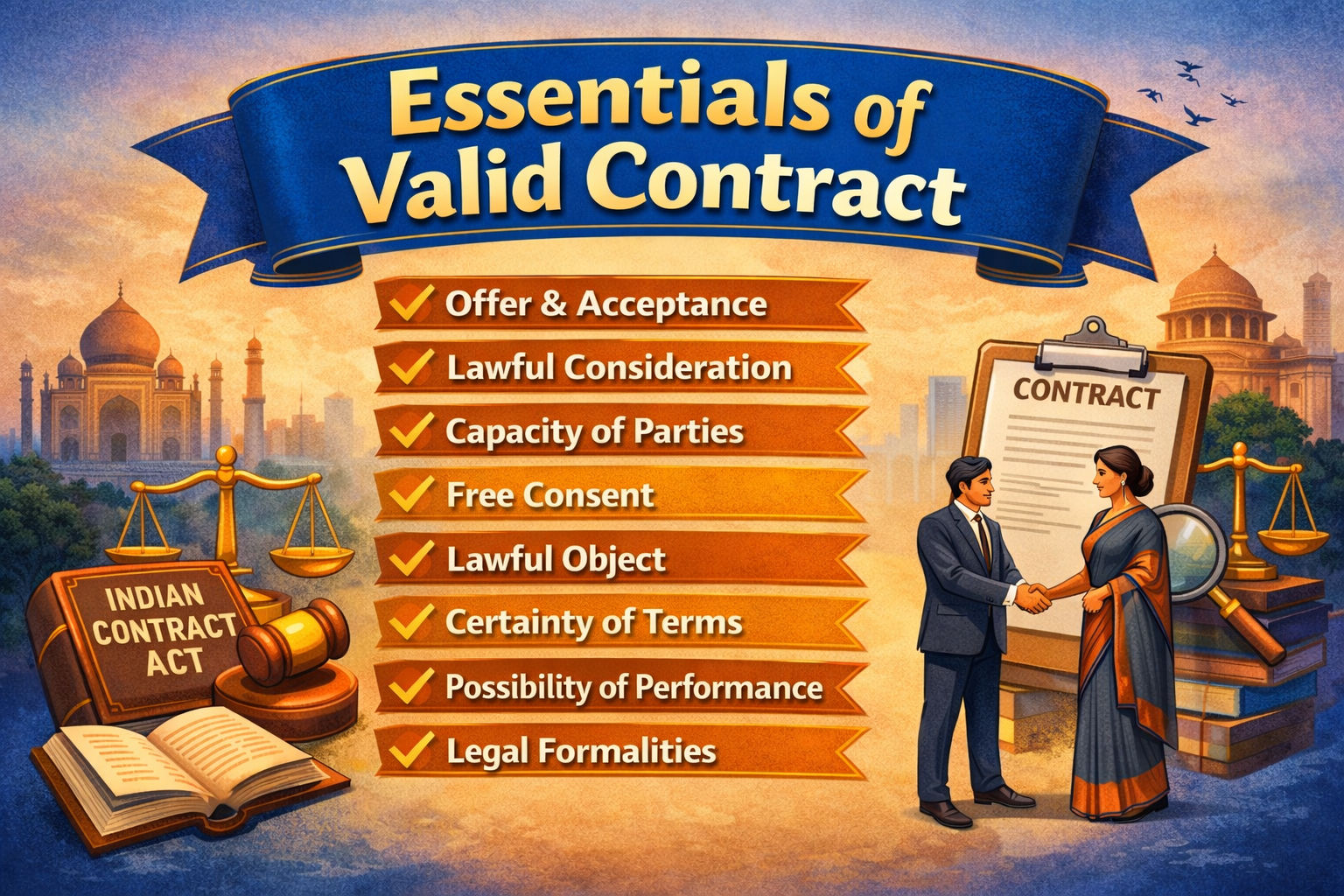
Have you ever wondered why some promises are legally binding while others are just “talk”? In India, the line between a casual handshake and a legally enforceable agreement is drawn by the Indian Contract Act, 1872 (ICA).
Whether you are a business owner, a freelancer, or a student, understanding the “essentials” of a contract is vital. Without these pillars, a contract is just a piece of paper—unenforceable in a court of law.
What defines a “Valid Contract”?
According to Section 2(h) of the ICA, a contract is “an agreement enforceable by law.” To reach that stage of “enforceability,” the agreement must satisfy the conditions laid down in Section 10. If any of these elements are missing, the contract may be deemed void (not valid from the start) or voidable (can be cancelled by one party).
1. Offer and Acceptance (Section 2)
Every contract begins with one party making an Offer (Section 2a) and the other party giving their Acceptance (Section 2b).
- The offer must be clear and communicated.
- The acceptance must be absolute and unqualified.
Landmark Case: Lalman Shukla v. Gauri Dutt (1913). The court ruled that an acceptance cannot happen without the knowledge of the offer. If you find a lost boy without knowing there was a reward offered, you cannot later claim the reward.
2. Intention to Create Legal Relationship
The law doesn’t care about social or domestic promises. If you promise to take your spouse out for dinner and fail to do so, they cannot sue you for breach of contract. There must be an intention to face legal consequences if the promise is broken.
Landmark Case: Balfour v. Balfour (1919). This case established that domestic agreements between husband and wife are generally not intended to be legal contracts.
3. Lawful Consideration (Section 25)
Consideration is the “price” paid for the promise. It is the Quid Pro Quo—something in return. A contract without consideration is generally void.
- It doesn’t have to be money; it can be a service, goods, or even a promise to refrain from doing something.
- It must be real and have some value in the eyes of the law.
4. Capacity of Parties (Section 11)
Not everyone is legally “competent” to sign a contract. Under Section 11, a person is competent if:
- They have attained the age of majority (18 years).
- They are of sound mind (capable of understanding the terms).
- They are not disqualified by any law (e.g., an undischarged insolvent).
Landmark Case: Mohori Bibee v. Dharmodas Ghose (1903). The court held that any contract with a minor is void-ab-initio (void from the very beginning).
5. Free Consent (Sections 13 & 14)
For a contract to be valid, the parties must agree on the same thing in the same sense (Consensus ad idem). Furthermore, that consent must be “free.” Consent is NOT free if it is obtained by:
- Coercion (Section 15): Physical threats or force.
- Undue Influence (Section 16): Misusing a position of power.
- Fraud (Section 17): Intentional deception.
- Misrepresentation (Section 18): Innocent but false statements.
- Mistake (Sections 20, 21 & 22): Errors regarding the facts of the agreement.
6. Lawful Object (Section 23)
The purpose of the contract must be legal. You cannot have a valid contract to smuggle goods, commit a crime, or do something “opposed to public policy.” If the object or the consideration is unlawful, the contract is void.
7. Certainty and Possibility of Performance (Sections 29 & 56)
A contract must be clear. If “A” agrees to sell “B” “some oil,” but doesn’t specify what kind (coconut, mustard, or engine oil), the contract is void due to uncertainty.
Similarly, a contract to do an impossible act—like discovering treasure by magic—is void under Section 56 (Initial Impossibility).
Summary Table
| Essential Element | Section (ICA) | Key Requirement |
| Agreement | Sec 2(e) | Offer + Acceptance. |
| Capacity | Sec 11 | 18+ years, Sound mind. |
| Free Consent | Sec 14 | No pressure, fraud, or force. |
| Consideration | Sec 25 | Something in return (value). |
| Lawful Object | Sec 23 | Purpose must be legal. |
Conclusion
A valid contract is the backbone of stable commerce. By ensuring your agreements meet the criteria of Section 10, you protect your interests and ensure that the law stands behind your “Yes.” When in doubt, always check for the “three C’s”: Capacity, Consideration, and Consent.
Comments 0