
DIMENSIONS OF THE JUDICIAL PROCESS
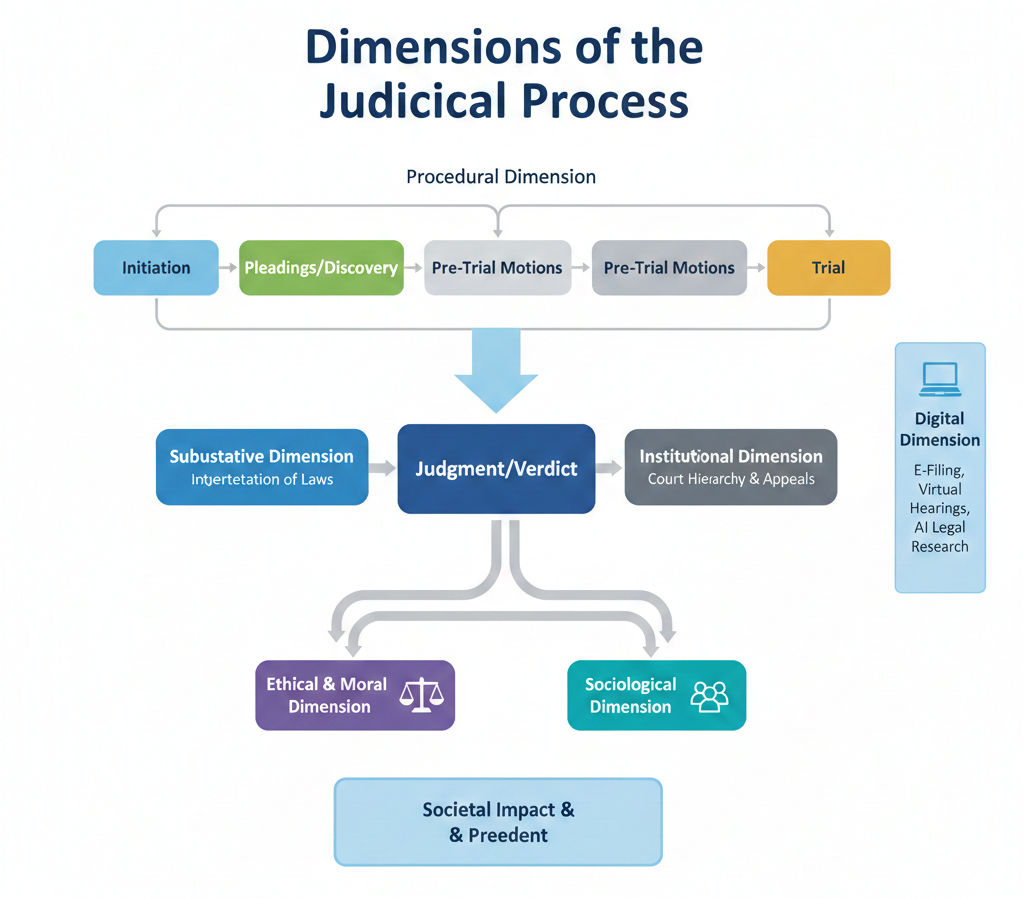
The judicial process is often viewed as a simple straight line: a crime is committed, a trial happens, and a judgment is passed. However, for those within the legal sphere, it is a multi-dimensional architecture designed to balance power, ensure fairness, and uphold the rule of law.
Understanding these dimensions is crucial—not just for law students, but for every citizen. In this blog, we explore the intricate layers of the judicial process and how they function to keep the wheels of justice turning.
1. The Procedural Dimension: The Rules of the Game
At its core, the judicial process is governed by Procedural Law. This dimension ensures that justice is not arbitrary. It dictates how a case enters the system, how evidence is presented, and how a trial is conducted.
- Due Process: This is the bedrock of the procedural dimension. It guarantees that every individual receives a fair hearing and that the state respects all legal rights owed to a person.
- Adversarial vs. Inquisitorial Systems: Depending on the jurisdiction, the process may be a “battle” between two parties (Adversarial) or a collaborative investigation led by the judge (Inquisitorial).
2. The Substantive Dimension: The Heart of the Matter
While procedure defines how we litigate, the substantive dimension defines what we are litigating. It involves the interpretation of the actual laws—the statutes, constitutional provisions, and penal codes.
In this dimension, the judiciary acts as an interpreter. When a law is vague, the court must determine the legislative intent. This is where the “spirit of the law” often meets the “letter of the law.”
3. The Institutional Dimension: The Power Structure
The judicial process does not exist in a vacuum; it functions within an institutional framework. This dimension focuses on the hierarchy and independence of the courts.
- Hierarchy of Courts: From trial courts to the Supreme Court, the hierarchical structure allows for a system of Appellate Review, ensuring that errors made at lower levels can be corrected.
- Judicial Independence: For a process to be truly just, the judiciary must be free from the influence of the executive and legislative branches. Without this institutional autonomy, the judicial process becomes a tool for political gain rather than justice.
4. The Ethical and Moral Dimension
Law is not always synonymous with justice. The ethical dimension of the judicial process involves the philosophy of Jurisprudence. Judges often have to grapple with moral dilemmas—balancing the strict requirements of the law with the evolving ethical standards of society.
Concepts like Equity play a massive role here. Sometimes, following the strict law might lead to an unfair result; in such cases, courts use equitable principles to provide a remedy that is fair and just.
5. The Sociological Dimension: Impact on Society
The judicial process is a living entity that affects—and is affected by—society. This dimension looks at how court decisions shape social norms and how social movements influence legal changes.
- Judicial Activism: Sometimes, the court takes a proactive role in protecting the rights of the marginalized, filling the gaps left by the legislature.
- Public Policy: Landmark judgments often set the tone for national policy on issues like environmental protection, civil rights, and privacy.
The Role of Technology in the Modern Judicial Process
We cannot discuss the dimensions of justice in 2026 without mentioning the Digital Dimension. From e-filings and virtual hearings to the use of AI in legal research, technology is making the judicial process more accessible and efficient. However, it also introduces new challenges regarding data privacy and the “digital divide” in legal access.
Why Does This Matter?
The judicial process is the ultimate safeguard of a democracy. When we understand its various dimensions—procedural, substantive, institutional, ethical, and sociological—we become better equipped to hold the system accountable.
Justice is not just a destination; it is a rigorous, multi-faceted process that requires constant vigilance and evolution.
Comments 0