
CONCEPT, NATURE, AND SCOPE OF JURISPRUDENCE
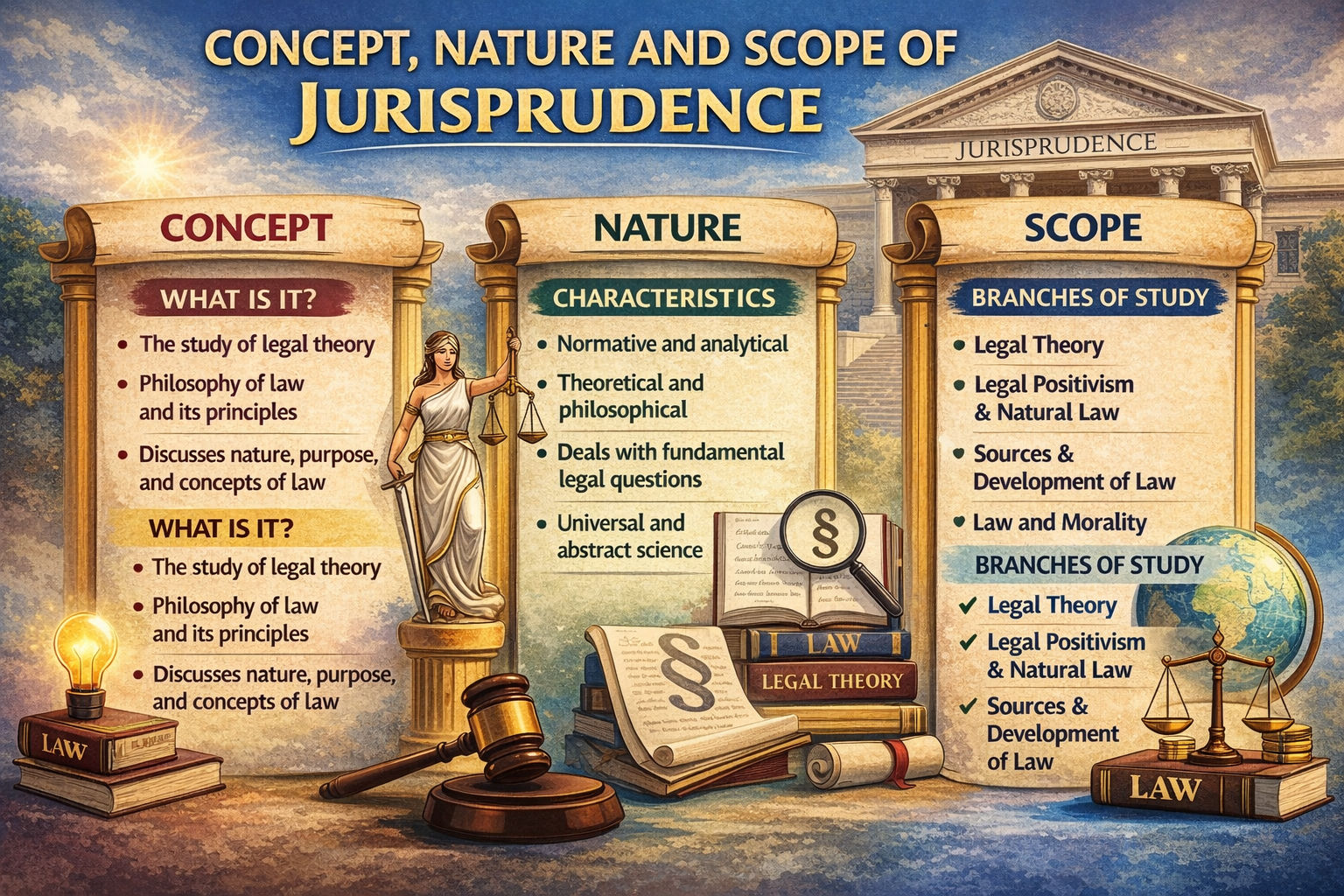
For many, the law is a collection of “thou shalt's” and “thou shalt nots”—a rigid set of rules found in thick, dusty volumes. However, to the legal scholar, the law is a living, breathing organism. The heartbeat of that organism is Jurisprudence. Often called the “grammar of law,” jurisprudence is the study that allows us to look past the written word of a statute to understand the soul of justice itself.
In this comprehensive guide, we will explore the concept, nature, and the vast province (scope) of jurisprudence to understand why it remains the most vital subject in legal education.
1. The Concept of Jurisprudence: Defining the “Eye of Law”
The term “Jurisprudence” finds its roots in the Latin word Jurisprudentia—a compound of juris (law) and prudentia (wisdom, knowledge, or skill). Literally translated, it is the knowledge of law. However, in a professional and academic context, it refers to the philosophical and scientific study of the principles on which legal systems are built.
Jurisprudence does not focus on a specific piece of legislation, such as the Indian Penal Code or the British Road Traffic Act. Instead, it asks the “Big Questions”:
- What is the origin of law?
- Is law separate from morality, or are they inextricably linked?
- What is the difference between “having a rule” and “being obliged” to follow it?
Perspectives from Great Jurists
Because the concept is so broad, different thinkers have viewed it through different lenses:
- The Romans: Viewed it as the “knowledge of things divine and human.”
- Jeremy Bentham: Known as the “Father of Jurisprudence,” he divided the study into Expository (what the law is) and Censorial (what the law ought to be).
- John Austin: He famously defined it as the “Philosophy of Positive Law,” focusing strictly on the laws set by a political superior to a political inferior.
- Salmond: He took a more practical approach, calling it the “Science of the first principles of the civil law.”
2. The Nature of Jurisprudence
The nature of jurisprudence is often misunderstood because it is not “law” in the traditional sense. It has several distinct characteristics:
A. It is a “Social Science”
Jurisprudence is not a physical science like Chemistry; it is a social science. It studies human behavior, social interests, and the evolution of society. It seeks to understand how legal rules influence human conduct and how, in turn, human needs shape the law.
B. It is Analytical and Philosophical
Unlike a courtroom trial which is concerned with facts and evidence, jurisprudence is concerned with logic. It analyzes legal concepts like Right, Duty, Possession, Ownership, and Liability. It provides the intellectual tools to break down complex legal problems.
C. It is Normative
Jurisprudence is concerned with “norms”—the standards of behavior. It evaluates whether a law is “good” or “bad” based on various theories of justice. This is known as the normative nature of law, where the focus is on values rather than just mechanics.
D. It is Un-codified
You cannot go to a library and find a “Code of Jurisprudence.” Its nature is fluid and exists in the collective wisdom of judicial precedents, legal treatises, and the evolving moral standards of the community.
3. The Province and Scope of Jurisprudence
The “province” refers to the territory or the boundaries of the subject. In the early 19th century, the province of jurisprudence was considered quite narrow. Today, however, its scope has expanded to cover almost every aspect of human interaction.
The scope of jurisprudence can be broadly divided into three main areas:
I. The Study of Legal Concepts
This is the most “practical” part of the province. Jurisprudence investigates the fundamental building blocks of any legal system.
- Legal Personality: Who is a “person” in the eyes of the law? (e.g., Are corporations or idols “persons”?)
- Rights and Duties: What does it mean to have a right? Is there a duty for every right?
- Ownership and Possession: Why does the law distinguish between who “owns” an item and who is currently “holding” it?
II. The Schools of Legal Theory (The Philosophical Scope)
The province of jurisprudence is divided into various “schools,” each offering a different version of what law should be:
- Natural Law School: Asserts that law is derived from reason, nature, or God. If a law is immoral, it is not a true law (Lex iniusta non est lex).
- Analytical School (Positivism): Focuses on law “as it is.” It ignores morality and focuses on the command of the sovereign.
- Historical School: Argues that law is a product of history and the “spirit of the people” (Volksgeist).
- Sociological School: Views law as a tool for social engineering, balancing the needs of the individual against the needs of society.
III. The Relationship with Other Social Sciences
Modern jurisprudence has a massive scope because it intersects with other fields:
- Law and Ethics: Exploring how moral values translate into legal prohibitions.
- Law and Economics: Analyzing the efficiency of legal rules (e.g., how contract law affects the market).
- Law and Psychology: Investigating the “criminal mind” and how the law can deter behavior.
4. The Practical Utility of Jurisprudence
Why do we study this? Is it just for academic debate? No. Jurisprudence serves several vital functions:
- Interpretation: When a judge faces a “hard case” where the law is silent or ambiguous, they use jurisprudential principles to reach a fair decision.
- Legal Education: It trains the mind of a lawyer to look for the “ratio decidendi” (the reason for a decision) rather than just the conclusion.
- Law Reform: By studying the failures of current laws through a sociological lens, jurists can advocate for more effective legislation.
Conclusion
Jurisprudence is the foundation upon which the entire legal system rests. While the “Concept” introduces us to the wisdom of law, and the “Nature” explains its scientific and philosophical roots, the “Province” shows us that its reach is limitless. It ensures that the law does not become a stagnant pool of rules, but remains a flowing river that moves toward the ocean of justice.
Understanding jurisprudence is not just about passing an exam; it is about understanding the very fabric of the society we live in.
Comments 0