
Muslim Law in India: Status, Scope, and Recent Changes
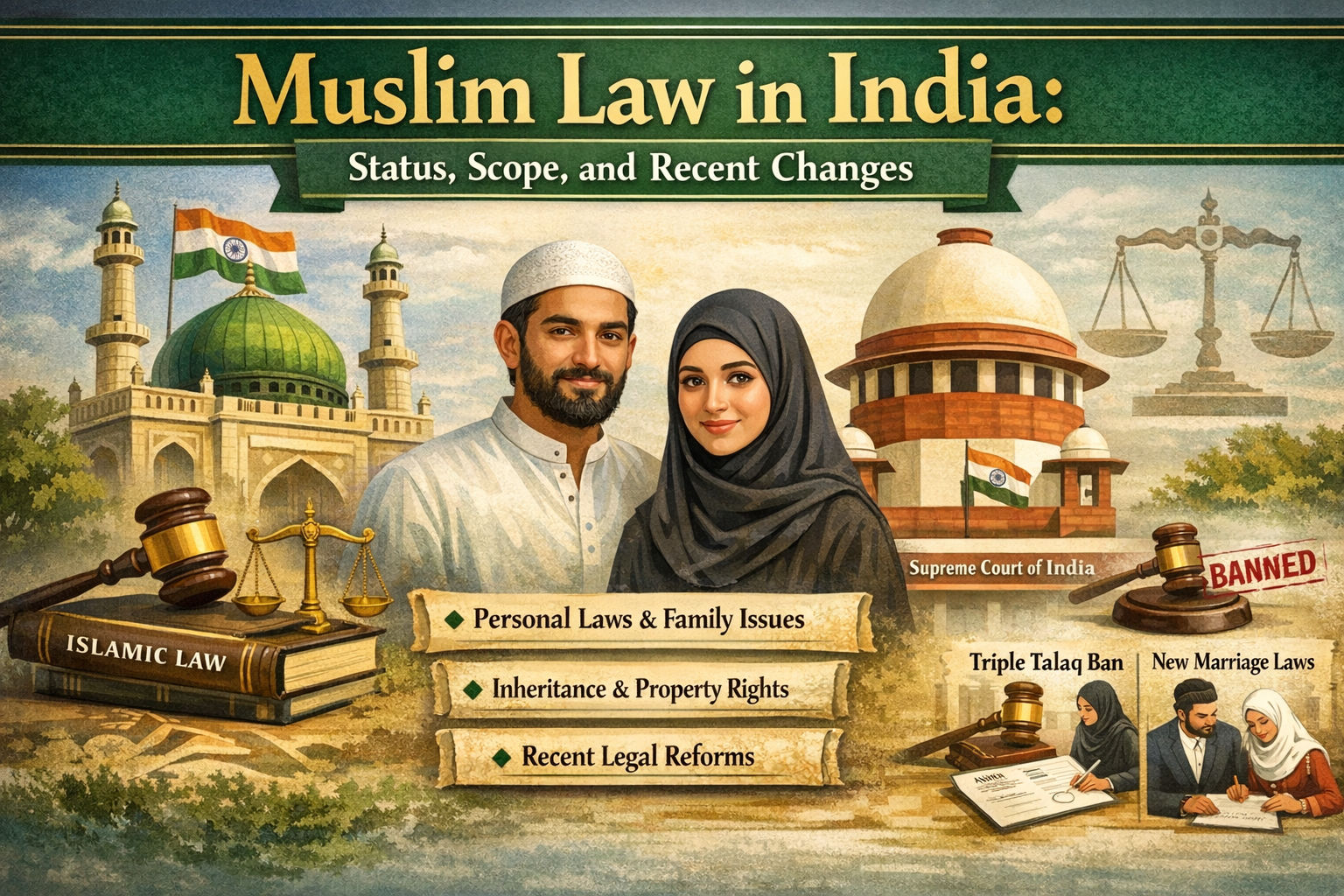
India, a land of unparalleled diversity, is home to a multitude of personal laws governing its various religious communities. Among these, Muslim Personal Law holds a unique and often debated position. Far from being a monolithic entity, its application and interpretation within the Indian legal framework present a fascinating interplay of religious tradition, constitutional principles, and societal evolution.
In this blog, we delve into the status and scope of Muslim Law in India, examining its historical context, its contemporary application, and the ongoing discussions surrounding its future.
The Foundational Status: A Question of Personal Law
Muslim Law in India primarily functions as Muslim Personal Law, a system of family laws derived from religious texts and traditions. Unlike criminal or contractual laws, which are uniform for all citizens, personal laws govern aspects such as marriage, divorce, maintenance, inheritance, adoption, and guardianship for specific religious communities.
The Constitution of India, through Article 44, envisages a Uniform Civil Code (UCC), aiming for a single set of personal laws for all citizens. However, until such a code is enacted, communities like Muslims are governed by their respective personal laws. This constitutional provision forms the backdrop against which Muslim Personal Law operates, creating an ongoing tension between the desire for uniformity and the recognition of religious freedom.
Sources and Interpretation: A Blend of Tradition and Jurisprudence
The primary sources of Muslim Law in India are:
- The Quran: The holy book of Islam, considered the ultimate divine revelation.
- Sunnah and Hadith: The practices and sayings of Prophet Muhammad.
- Ijma: Consensus of opinion among Muslim jurists.
- Qiyas: Analogical deductions based on the above sources.
However, in India, these classical sources are interpreted and applied through various statutes enacted by the Indian Parliament, as well as through judicial pronouncements.
Key legislation includes:
- The Muslim Personal Law (Shariat) Application Act, 1937: This pivotal act affirmed that in matters of marriage, divorce, maintenance, dower, gifts, wills, and inheritance, Muslims in India would be governed by Islamic personal law (Shariat) rather than local customs and usages.
- The Dissolution of Muslim Marriages Act, 1939: This act provided Muslim women with statutory grounds for seeking divorce, empowering them beyond traditional interpretations.
- The Muslim Women (Protection of Rights on Divorce) Act, 1986: Enacted after the landmark Shah Bano case, this act specifies the maintenance rights of divorced Muslim women.
It's crucial to understand that Indian courts play a significant role in interpreting these laws, often drawing upon principles of justice, equity, and good conscience, especially when traditional interpretations clash with modern constitutional values.
The scope of Muslim Personal Law in India is extensive within the realm of personal matters. It covers:
- Marriage (Nikah): Conditions for a valid marriage, polygamy (though increasingly scrutinized), and Mahr (dower).
- Divorce (Talaq): Various forms of divorce (Talaq-ul-Sunnat, Talaq-ul-Biddat), and the judicial limitations imposed on practices like instant triple talaq.
- Maintenance (Nafaqah): Rights of wives and divorced wives to financial support.
- Inheritance and Succession (Mirath): Detailed rules governing the distribution of property among heirs according to Islamic law, which often differs significantly from Hindu succession law.
- Wills (Wasiyat): Rules concerning the bequeathing of property.
- Gifts (Hiba): Regulations for making valid gifts.
- Guardianship (Wilayat): Laws relating to the custody and guardianship of minor children.
- Wakfs: Endowments made by Muslims for religious, pious, or charitable purposes, managed under specific Wakf Acts.
It's important to note what Muslim Personal Law does not cover. Criminal law, contract law, civil procedure, and property laws (outside of inheritance and gifts) are all governed by secular, uniform Indian statutes applicable to all citizens.
Evolving Dynamics and Challenges
The application of Muslim Personal Law in India is not static; it is constantly evolving, facing several key challenges and debates:
- Triple Talaq and Judicial Intervention: The practice of instant triple talaq (talaq-e-biddat) was a major point of contention. The Supreme Court of India, in the landmark Shayara Bano v. Union of India (2017) case, declared it unconstitutional, citing its arbitrary and discriminatory nature. This was followed by the Muslim Women (Protection of Rights on Marriage) Act, 2019, which criminalised instant triple talaq. This intervention highlights the judiciary's role in reforming personal laws to align with constitutional mandates of equality.
- Polygamy: While permitted under Muslim Personal Law for men, polygamy faces increasing social and legal scrutiny in India, often conflicting with principles of gender equality.
- Maintenance Rights of Divorced Women: The Shah Bano Begum v. Mohd. Ahmed Khan (1985) case sparked a national debate on the maintenance rights of divorced Muslim women, leading to the enactment of the 1986 Act, and subsequent re-interpretations by courts to ensure adequate provision.
- Uniform Civil Code (UCC) Debate: The most significant ongoing discussion revolves around the UCC. Proponents argue it would promote national integration, gender equality, and eliminate discrimination inherent in some personal laws. Opponents raise concerns about religious freedom and the erosion of cultural identity. The future of Muslim Personal Law is inextricably linked to this debate.
- Adoption: Traditional Muslim Law does not recognise full adoption in the same way secular laws do. While guardianship is permitted, the concept of a child completely severing ties with their biological family and becoming a full legal heir to the adoptive parents is not explicitly recognised, leading to complexities.
Conclusion: A Journey Towards Justice and Equality
The status and scope of Muslim Law in India represent a complex tapestry woven from religious tradition, legislative action, and judicial review. While it guarantees Muslims the right to be governed by their personal laws in family matters, this right is increasingly balanced against the fundamental principles of gender equality, human dignity, and justice enshrined in the Indian Constitution.
The debates surrounding triple talaq, maintenance, and the Uniform Civil Code underscore a vital truth: personal laws, even those rooted in religion, must ultimately co-exist within a democratic and secular framework that prioritises fairness and equity for all its citizens. The journey of Muslim Law in India is a dynamic one, reflecting the broader societal aspirations for a more just and inclusive future.
Comments 0