
Menstrual Health Now a Fundamental Right: Supreme Court’s Historic Verdict
Introduction
In the history of the Indian judiciary, the day 30 Jan '26 will be a milestone for Indian women and the female students' rights. The Hon'ble court, while adjudicating the PIL, stated that the menstrual health of the female student is a fundamental right in schools and educational institutions.
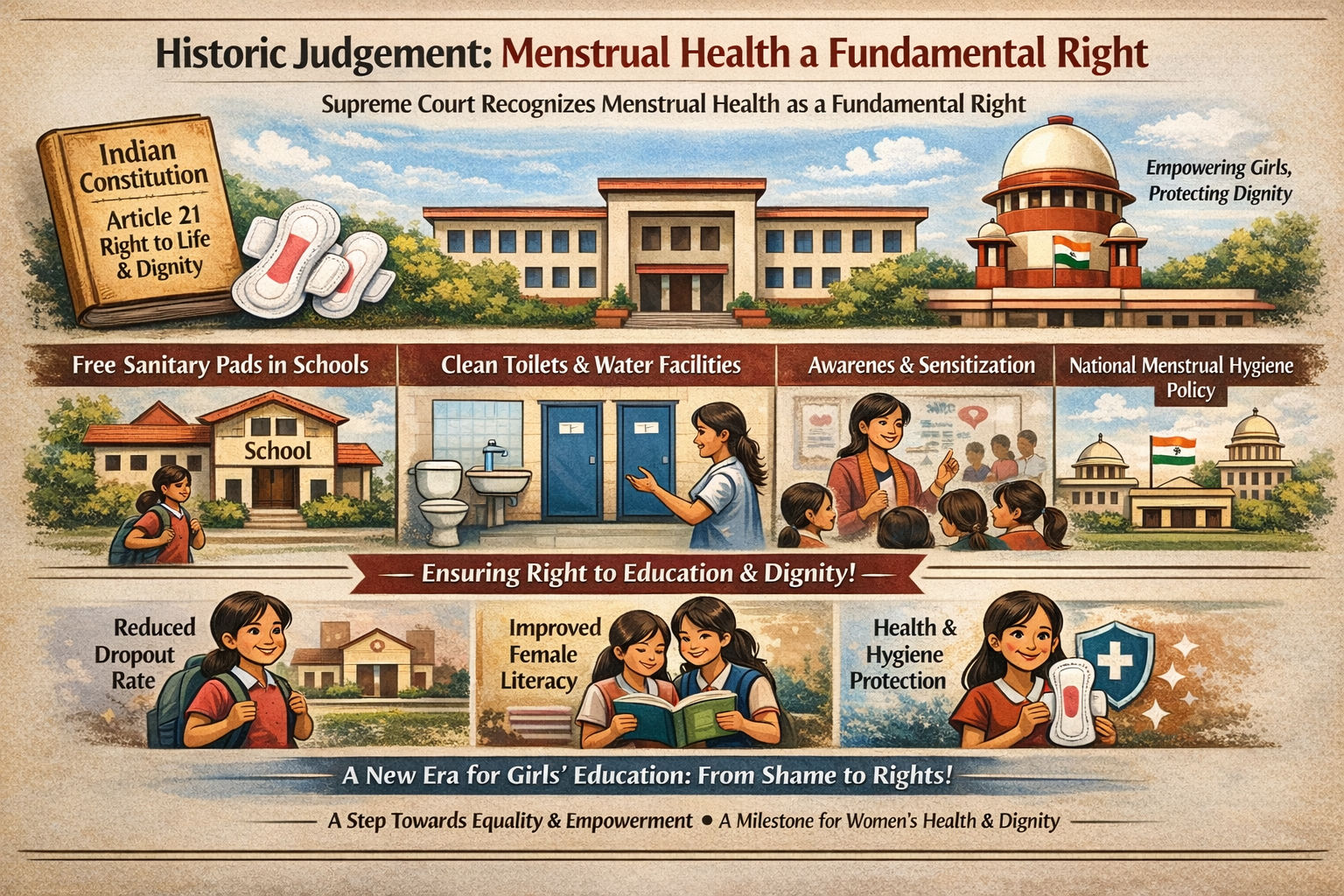
The Hon'ble court has clarified that this is not only the concept of a health issue; rather, this is the right under the Right to Life and Dignity provided by the Indian Constitution under Article 21.
Court's view: Article 21 and Dignity
The Supreme Court's bench during the proceedings noted that menstruation is a natural biological process. If the female student is not getting the basic facilities (such as sanitary pads, clean toilets, and clean water), then it is a direct violation of her dignity.
The court said, “A female student should not be deprived of education or should not leave the school because there are no facilities provided regarding menstrual hygiene management. This totally violates the right to life and dignity”.
Supreme Court's Directions
The court didn't even just state it, but the court issued the following directions to all the state governments:
1. Free sanitary pad distribution: The Court had directed that all the government schools, government-aided schools, and private schools will provide free sanitary pads and basic facilities to the students.
2. Hygiene and infrastructure: The school should ensure that separate clean toilets for girls, equipped with a proper clean water supply and disposal mechanisms, are available for the female students.
3. Sensitization and awareness: The court had also pointed out that all the taboos related to menstruation should be removed through sansitization program among the teachers, students, and guardians.
4. Need for a national policy: The Supreme Court directed the central government to strictly implement a "National Menstrual Hygiene Policy” and submit a progress report.
Impact on education
The data reveal that every year in India, millions of girls leave school just because there are no proper facilities provided concerning menstrual hygiene. The judgment is expected to bring some changes, such as-
1. Reduced dropout rate- when the school ensures and provides the basic facilities to the female students during their menstruation period, the students will come to study without hesitation.
2. Improvement in female literacy rate- This step helps to educate women more. This initiative helps to empower women in rural areas, also.
3. Protection from health risk- When a female uses dirty clothes and unhygienic alternatives during her period, these risks affect her health. By taking these measures, the female can be protected from infections and other health-related issues.
Significance of this order
If we think back then, since the decision was made, we can find that previously, menstruation was only a common health issue. But after connecting it to Article 21, the Supreme Court made it legally binding. Now, the school and the state government cannot say that "this is not mandatory, and we have no budget for that." mandatory, So now it is the fundamental right of the student, and violating it will be unconstitutional.
Conclusion
This decision is the sunrise for women towards their education. Recognising "menstrual health” in "fundamental rights” reflects that now, our democracy is becoming sensitive in respect to personal dignity and physical health. This decision is not only for free distribution; rather, it is about telling women that their biological needs are not a matter of shame but a matter of right.
Comments 0