
Supreme Court Questions ECI on West Bengal's Special Intensive Revision (SIR) 2026
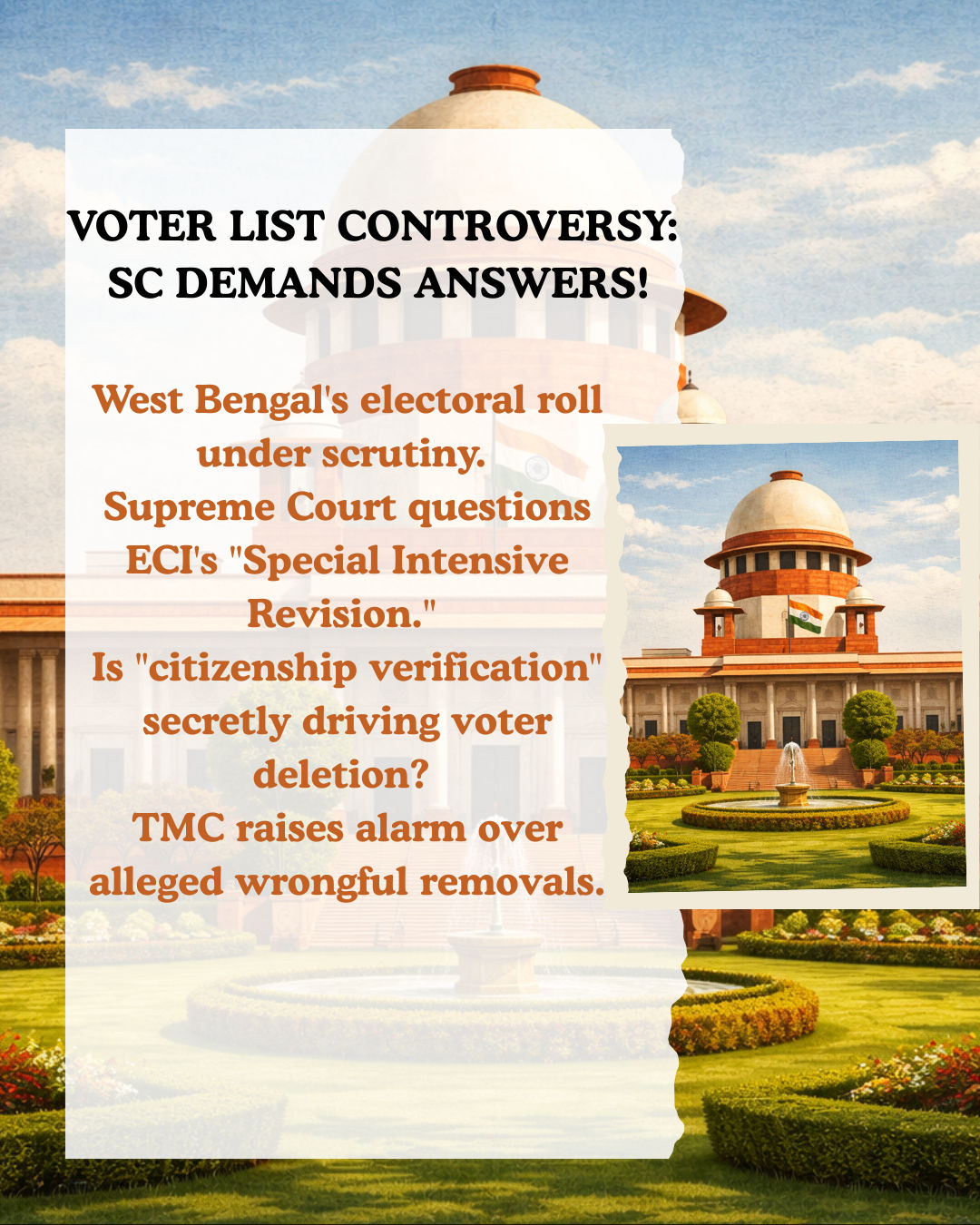
The sanctity of the electoral process is the bedrock of any democracy. However, when the process of maintaining voter lists becomes a point of legal contention, it raises fundamental questions about citizenship, administrative transparency, and constitutional rights. Recently, the Supreme Court of India took up a highly controversial matter involving the Special Intensive Revision (SIR) of electoral rolls in West Bengal, leading to a heated debate between the Election Commission of India (ECI) and political stakeholders.
What is the Special Intensive Revision (SIR) Controversy?
The controversy began when leaders from the Trinamool Congress (TMC) filed a petition challenging the ECI’s decision to conduct a "Special Intensive Revision" of the voter lists in specific districts of West Bengal. The petitioners alleged that names were being deleted from the electoral rolls arbitrarily, targeting specific communities under the guise of identifying "illegal immigrants."
The core of the legal battle lies in the discrepancy between the official orders issued by the ECI and the actual ground-level execution of the revision process.
The Supreme Court’s Stern Observations
During the hearing on January 22, 2026, the bench, including notable legal insights from the High Court’s earlier observations (Justice Joymalya Bagchi), scrutinized the ECI's mandate. The Court raised a pivotal question: If the official SIR order does not explicitly mention "citizenship verification" or "illegal immigration," why is the exercise being perceived and executed on those lines?
Key Legal Highlights from the Proceedings:
Lack of Transparency in Orders: The Court noted that the ECI’s written orders focused on technical "revision," but the narrative surrounding it was heavily leaned toward weeding out non-citizens.
The Scope of ECI’s Power: The Court questioned whether an intensive revision can legally transform into a citizenship verification drive without a clear statutory framework under the Citizenship Act or specific rules.
The "Illegal Immigration" Factor: Justice Bagchi pointed out that while illegal immigration is a sensitive and significant issue, using an electoral roll revision as a tool for "citizenship policing" without clear guidelines could lead to the disenfranchisement of genuine Indian citizens.
Why is SIR in West Bengal Different This Time?
Normally, the ECI conducts a "Summary Revision" every year. However, a "Special Intensive Revision" involves door-to-door verification and a more rigorous check of documents. In the context of West Bengal, a state that shares a porous border with Bangladesh, the term "voter list revision" often becomes synonymous with the debate over the National Register of Citizens (NRC) and the Citizenship Amendment Act (CAA).
The petitioners argued that the SIR was being used as a "backdoor NRC," causing panic among residents who fear losing their right to vote due to minor clerical errors in their old documents.
The Role of the Election Commission (ECI)
The ECI maintained that its primary goal is to ensure a "clean" and "error-free" voter list. They argued that removing "duplicate" or "shifted" voters is a routine administrative task necessary for fair elections. However, the Supreme Court’s intervention highlights a "procedural gap." If the ECI intends to verify citizenship, it must follow a legally defined process that allows the affected individual a fair chance to represent their case.
The Social and Political Implications
This legal battle is not just about paperwork; it has massive socio-political consequences:
Disenfranchisement: The biggest fear is that genuine citizens might be stripped of their voting rights without due process.
Polarisation: Such exercises often lead to political polarisation, where one side claims "national security" and the other claims "harassment of minorities."
Constitutional Integrity: The Supreme Court’s role as the protector of fundamental rights is crucial here. By questioning the "true intent" of the SIR, the Court is ensuring that administrative bodies do not overstep their constitutional boundaries.
Conclusion: The Road Ahead
The Supreme Court has sought a clearer explanation from the Election Commission regarding the criteria used for deleting names during the SIR. The outcome of this case will set a precedent for how voter lists are managed in border states across India.
For a democracy to thrive, the voter list must be accurate, but the process of cleaning it must be transparent, non-discriminatory, and rooted in the rule of law. As the case progresses, all eyes will be on how the ECI balances the need for security with the constitutional right to vote.
Comments 0