
The Judicial Bastion: Protecting Human Rights in a Constitutional Democracy
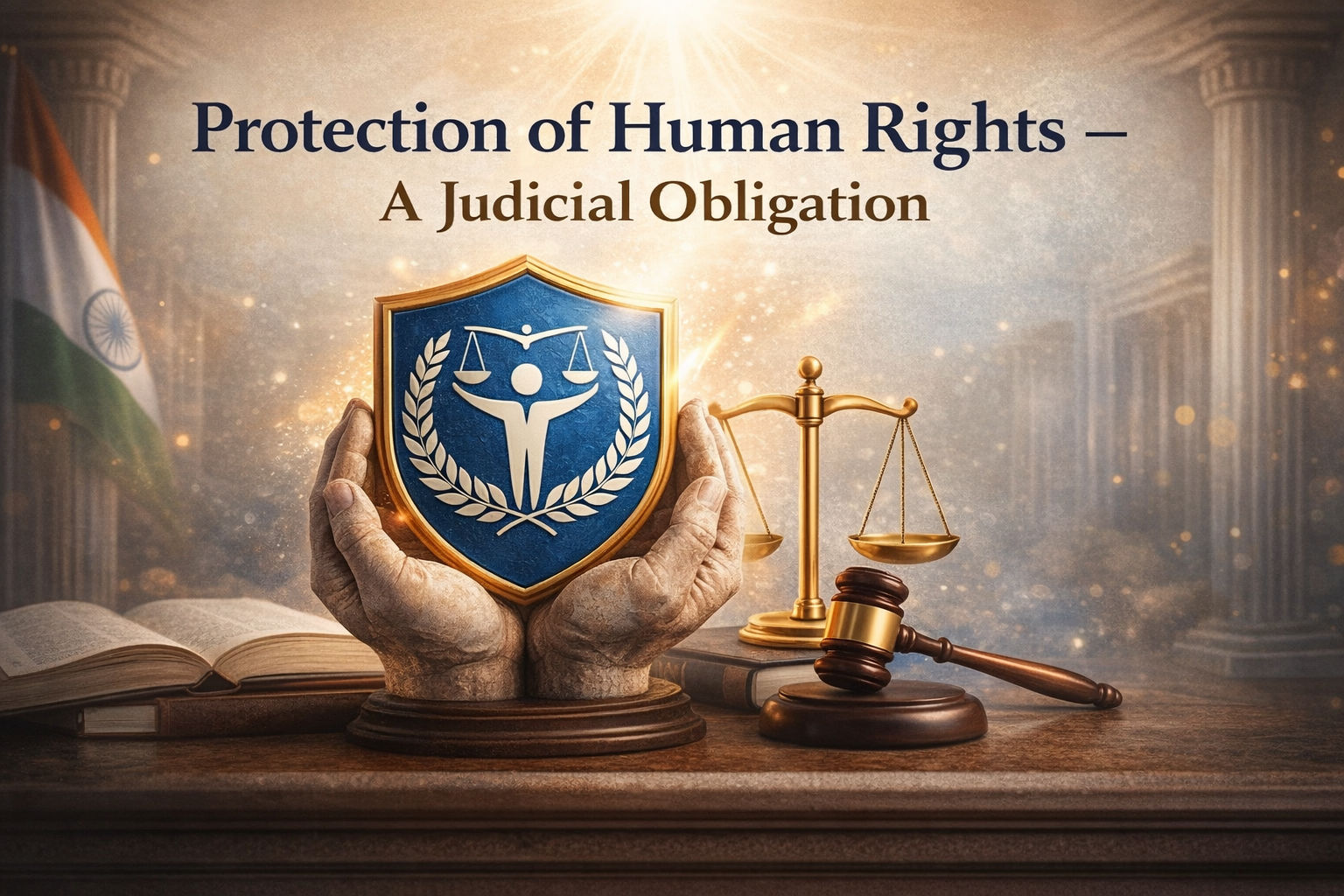
Human rights are inherent,
inalienable and universal rights that ensure the dignity, liberty and equality
of every individual. They form the moral and constitutional foundation of a
democratic society. In India, the protection of human rights is not merely a
legislative or executive function; it is a solemn and continuing obligation of
the judiciary. The judiciary, as the guardian of the Constitution, plays a
pivotal role in translating the ideals of human rights into lived realities.
The Constitution of India
embodies the spirit of human rights through its Fundamental Rights enshrined in
Part III. Articles 14, 19 and 21 constitute the golden triangle, guaranteeing
equality before law, fundamental freedoms and protection of life and personal
liberty. The judiciary has consistently interpreted these provisions
expansively to give substantive content to human dignity. Article 21, in
particular, has been judicially expanded to include the right to live with
dignity, right to livelihood, right to privacy, right to health, right to clean
environment and several other facets essential for meaningful human existence.
Judicial review is the most
significant tool through which courts protect human rights. By examining the
constitutionality of legislative and executive actions, courts ensure that
state power is exercised within constitutional limits. Any law or action that
violates fundamental rights can be struck down, thereby preventing
arbitrariness and abuse of authority. This power reinforces the rule of law and
upholds constitutional supremacy.
The evolution of Public Interest
Litigation (PIL) has marked a transformative phase in the Indian protection of
human rights. By liberalizing the rules of locus standi, the judiciary has
enabled access to justice for the poor, marginalized and disadvantaged sections
of society. Through PILs, courts have addressed issues such as custodial
violence, bonded labor, prison reforms, environmental protection and rights of
women and children. In doing so, the judiciary has acted as a voice for the
voiceless.
The judiciary also plays a
crucial role in harmonizing domestic law with international human rights norms.
Indian courts have frequently relied upon international conventions and
treaties, such as the Universal Declaration of Human Rights, when there is no
inconsistency with domestic law. This approach strengthens human rights
jurisprudence and aligns national legal standards with global values.
However, judicial obligation in
protecting human rights must be exercised with restraint and balance. While
judicial activism has contributed positively, overreach may disturb the
delicate balance of separation of powers. Therefore, judicial intervention must
remain principled, reasoned and constitutionally grounded.
In conclusion, the protection of
human rights is an indispensable judicial obligation in a constitutional
democracy. Through interpretation of fundamental rights, judicial review, PILs
and progressive jurisprudence, the judiciary ensures that human dignity is
preserved and justice is delivered. A vigilant, independent and sensitive
judiciary remains the strongest bulwark against human rights violations and is
essential for sustaining the rule of law and democratic governance.
Comments 0