
Rejection of Plaint: Order 7 Rule 11 CPC
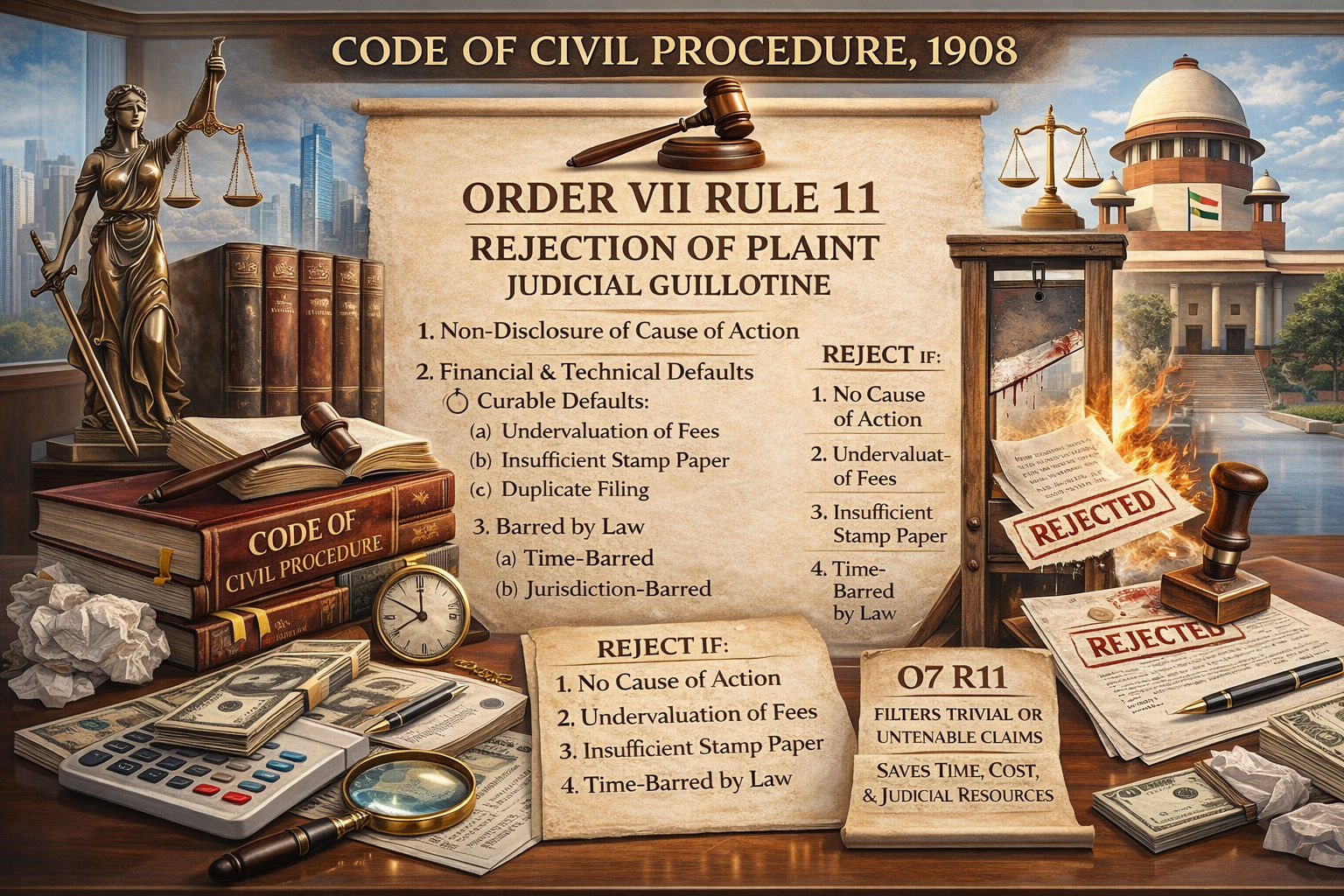
In the realm of civil litigation, the Code of Civil Procedure (CPC), 1908, acts as the manual for justice. Among its many provisions, Order VII Rule 11 (O7 R11) stands out as a powerful "threshold" provision. Often referred to by practitioners as the "Judicial Guillotine," it empowers the court to terminate a suit at its very inception if the plaint is fundamentally flawed.
The Statutory Framework: Bare Act Provision
Before diving into the analysis, it is crucial to look at the letter of the law. Order VII Rule 11 mandates the rejection of a plaint in specific, exhaustive scenarios:
11. Rejection of plaint.— The plaint shall be rejected in the following cases:—
(a) where it does not disclose a cause of action;
(b) where the relief claimed is undervalued, and the plaintiff, on being required by the Court to
correct the valuation within a time to be fix ed by the Court, fails to do so; (c) where the relief claimed is properly valued, but the plaint is returned upon paper insufficiently stamped, and the plaintiff, on being required by the Court to supply the requisite stamp-paper within a tim
e to be fixed by the Court, fails to do so; (d) where the suit appears from the statement in the plaint to be barred by a
ny la w; (e) where it is not filed in duplicate;
(f) where the plaintiff fails to comply with the provisions of rule 9.
The Proviso: The court may extend the time for correcting valuation or supplying stamps only if "exceptional nature" causes prevented the plaintiff from doing so, and where refusal would cause "grave injustice."
Decoding the Grounds
For a law student or practitioner, understanding the nuance behind these clauses is what wins cases.
1. Non-Disclosure of Cause of Action [Rule 11(a)]
The court looks for a "bundle of facts" which, if taken to be true, allows the plaintiff to seek a legal remedy. If the plaint is vague or doesn't link the defendant's actions to a legal injury, it fails here.
2. Financial & Technical Defaults [Rule 11(b), (c), (e) & (f)]
These are "curable" defects. The court usually gives the plaintiff a chance to fix undervaluation or pay the correct court fees. However, as per the Proviso, extensions are not a matter of right but are granted only in "exceptional circumstances."
3. Barred by Law [Rule 11(d)]
This is the most litigated ground. If the suit is filed beyond the period of limitation (e.g., filing a money suit after 3 years), or if a specific law (like the SARFAESI Act or WAQF Act) bars civil court jurisdiction, the plaint must be rejected.
The "Four Corners" Doctrine
The Supreme Court has repeatedly held (e.g., in Saleem Bhai v. State of Maharashtra) that when deciding an O7 R11 application:
The court must only look at the statements in the plaint.
The court cannot look at the Defendant’s Written Statement or evidence.
The court must assume the plaintiff's story is 100% true for the sake of this decision.
Strategic Insights for Practitioners
If you are representing a defendant in a suit that feels like "legal harassment" or "clever drafting," an O7 R11 application is your strongest shield. It saves the client from the "agony of a long-drawn trial."
Note: Always check the Limitation and Court Fees immediately upon receiving a copy of the plaint.
Conclusion
Order VII Rule 11 is the guardian of judicial efficiency. By filtering out frivolous or legally untenable claims at the doorstep, it ensures that the "stream of justice" remains unclogged.
Comments 0