
Jurisdiction of Civil Courts under CPC
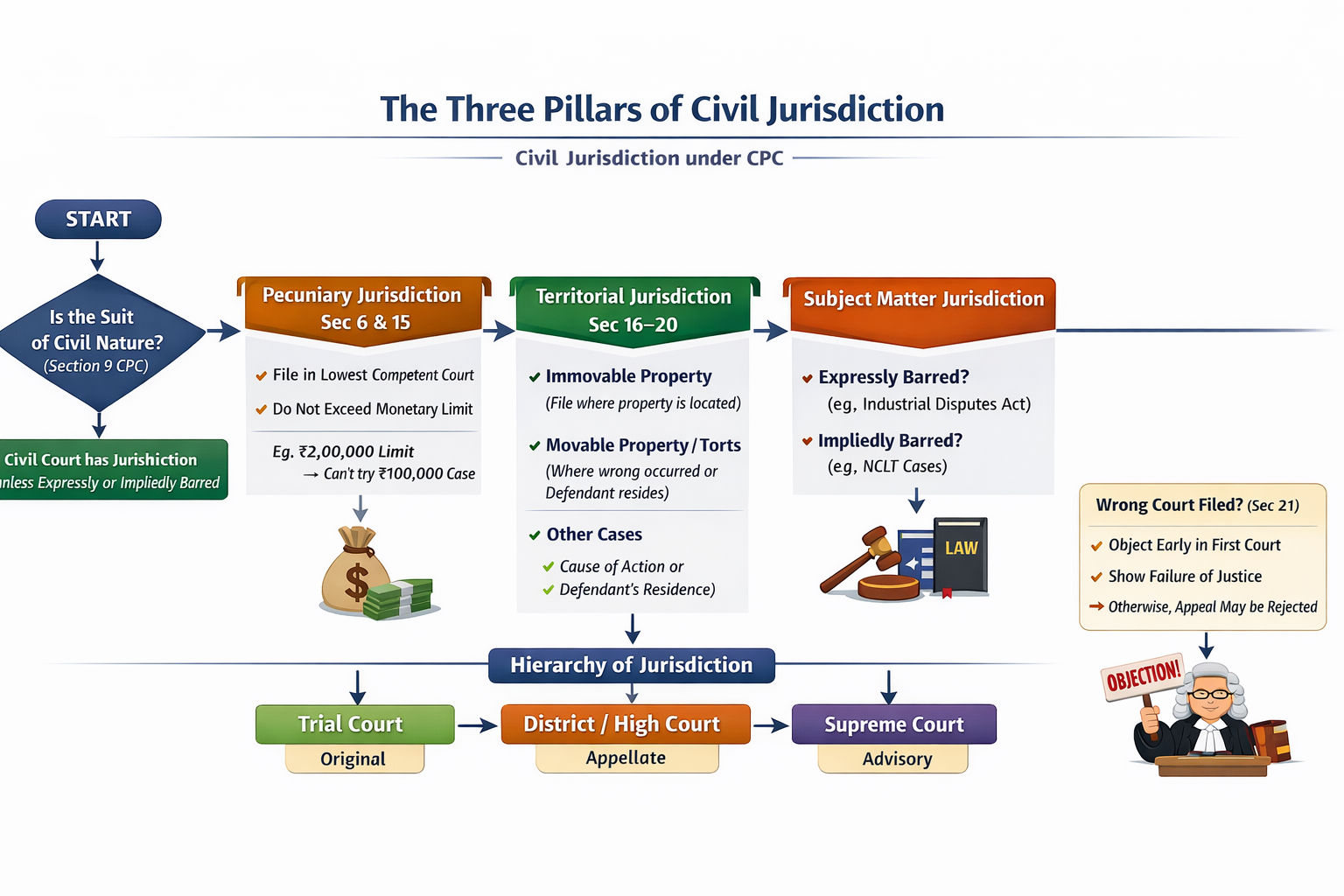
For any budding litigator, the first question to ask before drafting a plaint is not "Do I have a case?" but rather, "Which court has the authority to hear it?" In legal terms, this authority is called Jurisdiction.
Under the Code of Civil Procedure (CPC), 1908, jurisdiction is the power of a court to settle a dispute and pronounce a binding judgment. If a court lacks jurisdiction, its decree is a "nullity" (legally void).
The Three Pillars of Civil Jurisdiction
In India, a civil court must satisfy three primary criteria to entertain a suit. Think of these as the "coordinates" that lead you to the correct courtroom.
1. Pecuniary Jurisdiction (Section 6 & 15)
"Pecuniary" refers to money. Every court in the Indian judicial hierarchy has a financial ceiling.
Section 15 dictates that a suit must be filed in the court of the lowest grade competent to try it. This prevents higher courts from being overburdened with small-value claims.
Section 6 clarifies that a court cannot exceed its vested monetary limits. For example, if a Junior Civil Judge’s limit is ₹2,00,000, they cannot hear a property dispute valued at ₹10,00,000.
2. Territorial Jurisdiction (Sections 16 to 20)
This determines the geographical limits of a court’s power. The CPC classifies this based on the subject of the lawsuit:
Section 16: The General Rule (Where the property is situated)
This is the foundational rule. It states that suits must be instituted in the Court within whose local limits the property is situated.
This applies to suits for:
Recovery: Getting possession of the property back.
Partition: Dividing a family property among heirs.
Foreclosure/Sale/Redemption: Disputes related to mortgages or charges on the land.
Determination of Rights: Any other right or interest in immovable property.
Compensation for Wrongs: Damages for trespass or damage to the property.
The Exception (Proviso): If the relief sought can be obtained through the personal obedience of the defendant (like a specific performance of a contract), and the defendant resides or works within a different court's jurisdiction, the suit can be filed there instead.
Movable Property & Torts (Section 19): For personal "wrongs" (like defamation or a car accident), the plaintiff has a choice: file where the wrong occurred or where the defendant resides/works.
The "Residuary" Rule (Section 20): For all other cases (like contract breaches), the suit is filed where the Cause of Action arises (where the contract was signed or broken) or where the Defendant resides.
3. Subject Matter Jurisdiction
This is the "type" of case. Some courts are barred from hearing specific disputes regardless of value or location.
Section 9 is the heart of civil litigation. It states that civil courts have the power to try all suits of a civil nature unless they are expressly or impliedly barred.
Expressly Barred: When a statute clearly says a civil court cannot hear it (e.g., Industrial Disputes Act).
Impliedly Barred: When the suit is against public policy or falls under the exclusive domain of a special tribunal (e.g., the NCLT for company matters).
| Type of Jurisdiction | Stage of Litigation |
| Original | The power to hear a case at its inception (Trial Courts). |
| Appellate | The power to review and overturn lower court orders. |
| Advisory | Specifically for High Courts or the Supreme Court to give opinions on legal questions. |
When Things Go Wrong: Objections (Section 21)
What happens if a plaintiff files in the wrong court?
The defendant must raise an objection to jurisdiction at the earliest possible opportunity.
According to Section 21, an appellate court will generally not entertain a jurisdictional objection unless:
The objection was raised in the court of first instance.
It was raised at the earliest possible time (usually before issues are settled).
There has been a consequent failure of justice.
Conclusion
Jurisdiction is the foundation of any civil proceeding. For law students, mastering Sections 15 to 20 of the CPC is essential. Filing in a court without jurisdiction is a waste of time and resources, as the entire proceeding can be set aside at a later stage.
Note: Always calculate the "valuation of the suit" and the "cause of action" carefully before deciding your forum!
Comments 0